



If your feed looks like ours this month, you have seen the claim. Glycerin, the clear syrupy ingredient in almost every tube of toothpaste, supposedly coats your teeth so thickly that it takes 27 rinses to come off, and while it is there, minerals cannot get back into the enamel. Google searches for “glycerin toothpaste” were flat all summer, hit a sharp peak on 3 September 2026, decayed for a week, and started climbing again on 10 September. “Glycerin-free toothpaste” is rising alongside it.
We sell glycerin by the quart and by the drum, in USP, technical and food-grade solutions, so this is not a story we can watch from a distance. What follows is what the molecule actually does, where the 27-rinse number came from, and the part of the glycerin story that genuinely deserved the alarm: a June 2007 morning when the U.S. Food and Drug Administration told the country to throw away toothpaste, because what was in the tube was not glycerin at all.
Where the 27-rinse number comes from
The claim is older than the platform it is spreading on. It traces to Gerard F. Judd, who described himself as a chemistry Ph.D. and self-published a book called Good Teeth, Birth to Death in the late 1990s, followed by letters to readers. The line that survives is that glycerin in toothpaste is so sticky it “takes 27 washes to get it off,” and that teeth under it cannot re-mineralise. Neither the book nor the letters attach a study to the number, and the sites that have gone looking for one since, including the natural-living blogs that would most like to find it, report that there is none.
That matters more than it sounds. Twenty-seven is a strangely precise figure for a claim with no measurement behind it, and precision is what makes it travel: it sounds like the output of an experiment. The honest position, and the one we would hold ourselves to on a Certificate of Analysis, is that a number without a method is not a result. It is a sentence.
Dental researchers have not run a large controlled trial on the question either way, and this article is not dental advice; if you have a question about your own teeth, ask a dentist. What we can do is the chemistry, because the chemistry does not need a trial. It needs a look at the molecule.
What glycerin actually is
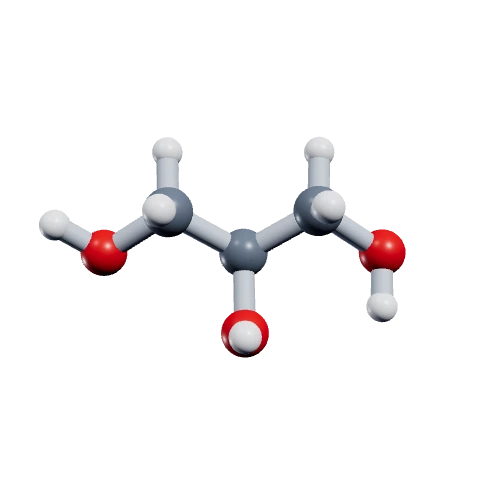
Glycerin is the common name for glycerol, propane-1,2,3-triol: a three-carbon chain with a hydroxyl group on every carbon. Formula C₃H₈O₃, molecular weight 92.09, CAS 56-81-5. Those three hydroxyl groups are the whole personality of the molecule. Each one hydrogen-bonds to water, and to the other glycerin molecules around it, which is why it behaves the way it does on the bench.
| Property | Value | What it means in practice |
|---|---|---|
| Water solubility | Miscible | Mixes with water in every proportion. There is no ratio at which glycerin and water separate. |
| Hygroscopic | Yes | Pulls water vapour out of the air. Leave a beaker open and it gains weight. |
| Viscosity at 25 °C | 954 cP | Roughly a thousand times thicker than water (0.89 cP). This is the “syrup” people mistake for stickiness. |
| Density at 20 °C | 1.26 g/cm³ | A quarter denser than water; a gallon weighs about 10.5 lb. |
| Melting point | 64 °F (18 °C) | Pure glycerin can set solid in a cold warehouse, and the liquid supercools far below that. |
| Boiling point | 290 °C (decomposes) | Essentially non-volatile at room temperature. It does not evaporate off a surface; it has to be carried off. |
The viscosity row is the one that fuels the myth. Glycerin feels thick and slippery between the fingers, so it is easy to imagine it as a varnish. But viscosity is a property of the pure liquid, not of the mixture. The moment glycerin meets water it starts dissolving into it, and a 70% glycerin solution has a viscosity of about 17 cP, down from 954. Add more water and it thins to nothing. The hydroxyl groups that make pure glycerin cling to itself are the same groups that make it let go the instant there is water to hold instead.
Why it is in toothpaste at all
Toothpaste is a wet paste that has to stay a wet paste, in a tube, in a warm bathroom, for a year. Water alone would evaporate through the cap and leave a brick. Glycerin is the humectant: Crest’s own explainer describes it as the ingredient that “helps retain the moisture of the paste so it doesn’t dry out in the tube.” It also sweetens slightly, carries flavour, and gives the paste its slip. The same property puts it in skin lotions, e-liquids, cough syrups, hand sanitiser gels, and the fog fluid we wrote about for Halloween season: everywhere a formulator needs something to hold on to water.
Why a rinse-proof film is the wrong picture
Imagine the coating the claim describes: a layer of glycerin on enamel that survives 27 separate floods of water, in a mouth that produces saliva continuously. For that to happen, glycerin would need to prefer the tooth surface to water so strongly that water could not pull it off. Nothing in its data sheet supports that. It is miscible with water in all proportions; it has no oily, water-repelling part of the molecule; it does not react with hydroxyapatite; and the one thing it does do with water is dissolve into it, eagerly, in either direction.
Compare the things that genuinely do coat teeth and resist rinsing: the pellicle your own saliva lays down, plaque, and the tars in tobacco smoke. Those are proteins, biofilms and hydrophobic residues, which is to say the opposite of a small polar sugar alcohol. If glycerin behaved like them, it would be useless in a lotion, because it would never release the moisture it holds. Formulators use it precisely because it does.
None of this says anything about whether a given toothpaste works. That is a question for the fluoride or hydroxyapatite it carries, and for the dentist. It says only that the mechanism the viral claim proposes is not how this molecule behaves in water. And it leaves the more interesting question standing: if glycerin is not the villain, why does “glycerin in toothpaste” still make people uneasy? Because once, it should have.
The one time glycerin in toothpaste was dangerous, it wasn’t glycerin
On 1 June 2007, FDA issued a public advisory with a blunt instruction: consumers should examine toothpaste for labelling that says it was made in China and, out of an abundance of caution, throw it away. The agency had detained one shipment at the border containing “about 3 percent DEG by weight,” then found and tested tubes at a distribution centre and a retail store; “the highest level found was between 3–4 percent by weight.” The retail product was not labelled as containing DEG. Fourteen brands went on an import alert the same day.
DEG is diethylene glycol, C₄H₁₀O₃: an industrial solvent and antifreeze ingredient that happens to be a colourless, hygroscopic, viscous liquid. Set a vial of it next to a vial of glycerin and you cannot tell them apart by eye. Somewhere upstream of those tubes, someone had not tried very hard to. FDA said what had triggered its sampling: “reports of contaminated toothpaste from China found in several countries, including Panama.”
The 2007 advisory was careful about one thing, and so are we. FDA said it was “not aware of any U.S. reports of poisonings from toothpaste containing DEG.” Toothpaste is not meant to be swallowed. The concern was chronic exposure and accidental ingestion, particularly by children and by people with kidney or liver disease. The toothpaste episode is the near miss. The reason FDA reacted to a near miss so hard is what had happened in Panama the year before, and in Haiti a decade before that.
Every glycerin poisoning FDA reviewed shares three gaps
FDA’s Guidance for Industry on testing glycerin for diethylene glycol was first issued in May 2007, in the middle of the toothpaste episode, and revised in May 2023 after a new wave of poisonings. Its background section is a history of the same accident repeating, and it is worth quoting at length because the pattern is the point.
| Year | Where | What FDA records |
|---|---|---|
| 1937 | United States | Elixir sulfanilamide made with DEG as the solvent. “A total of 107 people died, many of them children.” The event produced the Federal Food, Drug, and Cosmetic Act. |
| 1995–96 | Haiti | Children admitted with sudden kidney failure, “resulting in at least 80 fatalities.” Cause: DEG-contaminated glycerin in acetaminophen syrup. |
| 1990–98 | Argentina, Bangladesh, India, Nigeria | Similar incidents that “resulted in the deaths of hundreds of children.” |
| 2006 | Panama | An outbreak of DEG poisoning “resulting in multiple cases of illness and death,” from cough syrup formulated with DEG sold as glycerin. |
| 2022–23 | At least seven countries | Paediatric syrups contaminated with DEG and EG, “associated with more than 300 fatalities—mostly in children under the age of 5.” Indonesian authorities found the contaminants in a propylene glycol excipient. |
We wrote up the 1937 case in full earlier this year, in Elixir Sulfanilamide: The 1937 Poisoning That Created the FDA. The 2022–23 wave, which the World Health Organization described as involving “diethylene glycol (DEG) and ethylene glycol (EG)”, “toxic chemicals used as industrial solvents and antifreeze agents,” is the reason FDA reopened the guidance. And a 2013 paper in Clinical Toxicology by CDC investigators of the Panama outbreak counts “more than 13 medication-associated, DEG mass poisonings” since 1937, “associated with more than 500 deaths.”
What FDA does next is the part nobody on social media is talking about. Having listed the incidents, the guidance lists what they have in common:
- The manufacturers “did not perform full identity testing on the glycerin raw material, including tests to quantify the amount of DEG present and to verify the purity of the glycerin received.”
- They “relied on the certificate of analysis (COA) provided by the supplier of the glycerin.”
- “The origin of the glycerin was not readily apparent from the COA. The COA obtained by the manufacturers of the liquid drug products was often a copy of a COA on the letterhead of the distributor from whom they had purchased the glycerin and not the COA provided by the original manufacturer of the glycerin. The chain of custody or distribution history of the glycerin was also not readily known, often because the glycerin might have been sold multiple times between its manufacture and its use.”

Read those three bullets as a distributor and they sting, because two of the three are about paperwork that passes through hands like ours. A certificate of analysis is a claim made by whoever signed it. Copied onto a second letterhead, it is the same claim with one less name attached. The 2022 wave, FDA notes, “resembles previous ones” in exactly this respect, down to a case where “the appearance of the label and COA of propylene glycol… suggested the component container’s content might differ from what the container label and COA stated.”
Colourless, viscous, hygroscopic, sweet enough to formulate into a children’s syrup: the reason DEG keeps getting sold as glycerin is that it looks like glycerin. And the reason it keeps getting through is that a CoA looks like a test.
The fix was an identity test with a limit in it
The regulatory answer to a substitute that passes by eye is a test that does not use eyes. Under 21 CFR 211.84, a drug manufacturer must run an identity test on each component before use, using the specific compendial test if one exists, on representative samples of each shipment of each lot. The United States Pharmacopeia rewrote its glycerin monograph in 2008 so that the identity test would catch DEG on its own: the revision became official on 15 May 2008 and replaced the old limit test with a gas chromatography procedure that quantifies diethylene glycol and ethylene glycol individually.

FDA’s 2023 guidance describes the result as a three-part identification. Test A is infrared absorption, which confirms that the material is glycerin but, in FDA’s words, “is not suitable for detection or quantitation of DEG or EG.” Test B is gas chromatography referencing the “Limit of Diethylene Glycol and Ethylene Glycol,” and “allows for quantitation of DEG and EG, if present, individually, down to the identified safety limit (NMT 0.10%).” Test C is an examination of the Test B chromatograms. The limit, not more than 0.10% of each, sits inside the identity test rather than in a separate purity section, which means a lot of glycerin that fails it is not merely impure. It is, for regulatory purposes, not glycerin.
A CoA is a claim. A chromatogram is a measurement. USP’s chief executive at the time, Roger L. Williams, called the 2008 revision “one of many safety nets that help assure U.S. citizens that the drugs they use are of good quality.” The net has a mesh size: 0.10%. The toothpaste FDA pulled in 2007 was thirty to forty times over it.
Two more details from the guidance are worth carrying around. First, FDA now recommends that the representative sample “is of each container of each lot”, not a sample of the lot, because the agency “has seen wide variability of DEG and EG contamination from container to container”; in the 2022 Indonesian case, nine drum samples from the same supply came back with widely different levels over the limit. Second, FDA published its own gas chromatography–mass spectrometry screening method for DEG in toothpaste in 2007, so the analysis is not exotic. Any contract laboratory with a GC can run it.
What this means if you buy glycerin from us
We carry glycerin in three grades, and the honest thing to say first is that the grade name tells you what the material is sold to, not what you have tested it as.
| Product | Grade | Where it belongs |
|---|---|---|
| Glycerin USP Grade | USP Grade | Anything that touches a drug product, a cosmetic, or food contact, and fog fluid people will breathe. Sold to the USP monograph, which is the one with the DEG and EG limit built into the identification test. |
| Glycerin Technical Grade | Technical Grade | Antifreeze and heat-transfer blends, adhesives, plasticiser work, process humectant. Industrial jobs where the pharmacopeia is not the specification. |
| Glycerin 75%, 50% and 25% | Food-Grade | Pre-diluted aqueous solutions for formulators who would otherwise be cutting the 99% material with water on site. |
Need the Certificate of Analysis for a lot? Just ask; we send it over at no charge. And then, if you are making a drug product, do what the guidance says and test it anyway. That is not us being modest about our paperwork. It is 21 CFR 211.84, and it exists because for eighty-six years the paperwork has occasionally been the problem. If you have never read a CoA critically, our guide to how to read a chemical Certificate of Analysis walks through what each line is and is not promising, and Understanding Chemical Grades covers what USP, technical and food-grade actually mean.
Three questions to ask any glycerin supplier, including us. Whose letterhead is the CoA on, and is that the manufacturer’s? Can you trace this lot back through every hand it passed through? Does the CoA report the USP Identification B result, with the DEG and EG numbers, or just a line that says “passes”? A supplier who can answer all three has read the same guidance you have.
Common questions
Does glycerin in toothpaste really coat your teeth for 27 rinses?
There is no published measurement behind the number. It traces to a self-published book and letters by Gerard Judd from the late 1990s, which attach no study to the claim. Chemically, glycerin is miscible with water in all proportions and hygroscopic, so a film that resists 27 rinses is not how the molecule behaves; the property that makes it useful as a humectant is that water can always take it back. Whether a particular toothpaste works is a question for a dentist, not for this article.
Why is glycerin in toothpaste in the first place?
It is the humectant. Toothpaste has to stay a moist paste for a year in a tube, and water alone would evaporate through the cap. Glycerin holds moisture, adds slip and a slight sweetness, and carries flavour. The same property is why it is used in lotions, e-liquids, syrups and fog fluid.
What happened with toothpaste and diethylene glycol in 2007?
On 1 June 2007 FDA advised consumers to discard toothpaste labelled as made in China and issued an import alert on fourteen brands, after detaining a shipment containing about 3% diethylene glycol by weight and finding retail tubes at 3–4%. DEG is an antifreeze ingredient that had been substituted for glycerin upstream. FDA reported no U.S. poisonings from the toothpaste; the concern was chronic exposure and accidental swallowing, especially by children.
What is diethylene glycol and why is it dangerous?
Diethylene glycol (C₄H₁₀O₃) is an industrial solvent and antifreeze ingredient. It is a colourless, viscous, hygroscopic liquid that looks like glycerin, which is why it has repeatedly been sold as glycerin. WHO describes DEG and ethylene glycol as toxic chemicals that can be fatal even in small amounts; FDA’s guidance records outbreaks in 1937, Haiti in 1995–96, Panama in 2006 and at least seven countries in 2022–23, with more than 300 deaths in the most recent wave.
What does the USP glycerin identity test check?
Three things. Test A, infrared absorption, confirms the material is glycerin. Test B, gas chromatography, quantifies diethylene glycol and ethylene glycol individually against a limit of not more than 0.10% each. Test C examines the Test B chromatograms. Because the limit sits inside the identification test, glycerin that fails it does not meet the monograph’s identity, not merely its purity.
Which glycerin grade should a formulator buy?
USP Grade for anything that touches a drug product, a cosmetic or food contact, and for fog fluid people will breathe, because it is sold to the monograph that carries the DEG and EG limit. Technical Grade for antifreeze blends, adhesives and other industrial uses. Pre-diluted food-grade solutions at 75%, 50% and 25% where the process would otherwise be diluting the 99% material on site. In every case, ask for the Certificate of Analysis, and if the material is going into a drug product, run the identity test on receipt as 21 CFR 211.84 requires.
References & Authoritative Sources
Physical properties are from PubChem; the 2007 toothpaste figures are from FDA’s own advisory; the poisoning history and testing requirements are quoted from FDA’s guidance for industry and the World Health Organization.
- Testing of Glycerin, Propylene Glycol, Maltitol Solution, Hydrogenated Starch Hydrolysate, Sorbitol Solution, and other High-Risk Drug Components for Diethylene Glycol and Ethylene Glycol: Guidance for Industry — U.S. Food and Drug Administration, CDER, May 2023 (Revision 1). Source of the incident history, the three common gaps, the 21 CFR 211.84 requirements and the description of the USP identity test.
- FDA Advises Consumers to Avoid Toothpaste From China Containing Harmful Chemical — FDA news release, 1 June 2007 (archived). Source of the 3% and 3–4% by weight figures, the import alert and the statement on U.S. poisonings.
- Gas Chromatography–Mass Spectrometry (GC-MS) Screening Procedure for the Presence of Diethylene Glycol in Toothpaste — FDA laboratory method, 2007.
- WHO urges action to protect children from contaminated medicines — World Health Organization, 23 January 2023. The 2022–23 wave: more than 300 fatalities, at least seven countries, DEG and EG named.
- Glycerin Monograph Revision Aims To Prevent Serious Health Hazards Associated With Diethylene Glycol-contaminated Glycerin — United States Pharmacopeia via ScienceDaily, March 2008. The 15 May 2008 effective date, the gas chromatography procedure and the Roger L. Williams quotation.
- PubChem: Glycerol (CID 753) — National Library of Medicine. Formula, molecular weight, solubility (“miscible”), viscosity (954 cP at 25 °C; 17 cP for a 70% solution), density, melting and boiling points; the NIOSH and Hawley physical descriptions.
- PubChem: Diethylene glycol (CID 8117) — National Library of Medicine. Formula C₄H₁₀O₃, and the physical description as a colourless, viscous, hygroscopic liquid.
- PubChem: Water (CID 962) — Dynamic viscosity 0.8949 cP at 25 °C, for the comparison with glycerin.
- Schier, J. G. et al. (2013). Characterizing concentrations of diethylene glycol and suspected metabolites in human serum, urine, and cerebrospinal fluid samples from the Panama DEG mass poisoning. Clinical Toxicology, 51(10), 923–929 — the count of more than 13 mass poisonings and more than 500 deaths since 1937.
- Fatalities Associated with Ingestion of Diethylene Glycol-Contaminated Glycerin Used to Manufacture Acetaminophen Syrup — Haiti, November 1995–June 1996 — CDC, MMWR 45(30).
- Glycerin in Toothpaste: What You Need to Know — Crest. The manufacturer’s own description of glycerin’s function as a humectant.
- The Glycerin in Toothpaste Myth: What You Need to Know — Whole New Mom. Cited as the origin trace for the Judd “27 washes” claim and for the finding that no supporting study exists.
Specifying glycerin and want the CoA before you order?
Tell us the grade, the container size and what the glycerin is going into, and we will send the Certificate of Analysis and the SDS before the drum leaves the dock. If you are not certain whether the application needs USP or technical grade, describe it; we would rather get it right than ship the wrong material.
See Glycerin USP Grade sizesKey numbers and sources
| Number | What it is | Source |
|---|---|---|
| 27 | Rinses the viral claim says glycerin survives; no study behind it | Judd, via Whole New Mom |
| Miscible / 954 cP | Glycerin water solubility / viscosity at 25 °C | PubChem CID 753 |
| 3–4% by weight | Diethylene glycol in imported toothpaste, 1 June 2007; 14 brands on import alert | FDA news release |
| 107 / at least 80 / more than 300 | DEG deaths: United States 1937 / Haiti 1995–96 / seven countries 2022–23 | FDA guidance, WHO |
| NMT 0.10% | USP limit for DEG and for EG in glycerin, inside Identification Test B | FDA guidance, May 2023 |
| 15 May 2008 | USP glycerin monograph revision became official | USP via ScienceDaily |
| 21 CFR 211.84 | Identity testing on representative samples of each shipment of each lot, before use | FDA guidance |
Related: Two Solids Make a Liquid. Why Deep Eutectic Solvents Are Still Waiting — another reason to read the assay and identity lines on a glycerin certificate of analysis.
Frequently asked questions
Does glycerin in toothpaste really coat your teeth for 27 rinses?
There is no published measurement behind the number. It traces to a self-published book and letters by Gerard Judd from the late 1990s, which attach no study to the claim. Chemically, glycerin is miscible with water in all proportions and hygroscopic, so a film that resists 27 rinses is not how the molecule behaves; the property that makes it useful as a humectant is that water can always take it back. Whether a particular toothpaste works is a question for a dentist, not for this article.
Why is glycerin in toothpaste in the first place?
It is the humectant. Toothpaste has to stay a moist paste for a year in a tube, and water alone would evaporate through the cap. Glycerin holds moisture, adds slip and a slight sweetness, and carries flavour. The same property is why it is used in lotions, e-liquids, syrups and fog fluid.
What happened with toothpaste and diethylene glycol in 2007?
On 1 June 2007 FDA advised consumers to discard toothpaste labelled as made in China and issued an import alert on fourteen brands, after detaining a shipment containing about 3% diethylene glycol by weight and finding retail tubes at 3–4%. DEG is an antifreeze ingredient that had been substituted for glycerin upstream. FDA reported no U.S. poisonings from the toothpaste; the concern was chronic exposure and accidental swallowing, especially by children.
What is diethylene glycol and why is it dangerous?
Diethylene glycol (C₄H₁₀O₃) is an industrial solvent and antifreeze ingredient. It is a colourless, viscous, hygroscopic liquid that looks like glycerin, which is why it has repeatedly been sold as glycerin. WHO describes DEG and ethylene glycol as toxic chemicals that can be fatal even in small amounts; FDA's guidance records outbreaks in 1937, Haiti in 1995–96, Panama in 2006 and at least seven countries in 2022–23, with more than 300 deaths in the most recent wave.
What does the USP glycerin identity test check?
Three things. Test A, infrared absorption, confirms the material is glycerin. Test B, gas chromatography, quantifies diethylene glycol and ethylene glycol individually against a limit of not more than 0.10% each. Test C examines the Test B chromatograms. Because the limit sits inside the identification test, glycerin that fails it does not meet the monograph's identity, not merely its purity.
Which glycerin grade should a formulator buy?
USP Grade for anything that touches a drug product, a cosmetic or food contact, and for fog fluid people will breathe, because it is sold to the monograph that carries the DEG and EG limit. Technical Grade for antifreeze blends, adhesives and other industrial uses. Pre-diluted food-grade solutions at 75%, 50% and 25% where the process would otherwise be diluting the 99% material on site. In every case, ask for the Certificate of Analysis, and if the material is going into a drug product, run the identity test on receipt as 21 CFR 211.84 requires.
About the author
Andre Taki
This article is for informational purposes only.


