

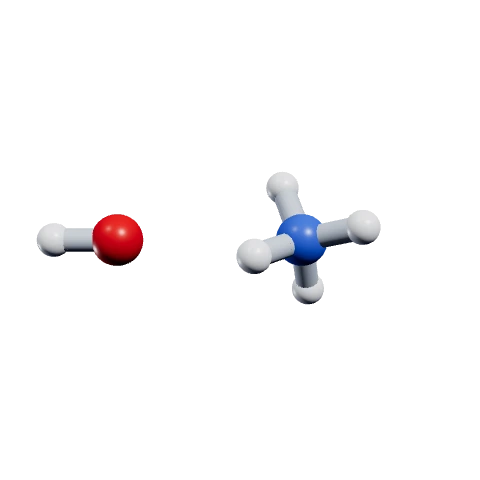


The same molecule that cleans semiconductor wafers in a $14 billion fab also lives in your glass cleaner. A field guide to NH4OH at industrial concentration: chemistry, six commercial uses, grade selection, and how to buy it without setting your shipping department on fire.
Ammonium hydroxide (NH4OH) is one of the most quietly important industrial chemicals in modern manufacturing. It cleans the silicon wafers in every smartphone you’ve ever owned. It darkens the cocoa in Dutch-process chocolate. It stabilizes natural rubber latex on its way from a Malaysian plantation to a hospital glove plant. It runs the buffer chemistry in thousands of analytical labs. And, in dilute form, it’s the active ingredient in your bottle of glass cleaner.
At 29%, ammonium hydroxide is the standard industrial concentration — strong enough to be useful in a single dose, dilute enough to handle (with proper PPE) without specialized cryogenic equipment. We supply 29% in both ACS Reagent Grade and Technical Grade, in pack sizes from 1-quart bottles to 275-gallon IBC totes. We field these specification questions every week from semiconductor procurement engineers, food formulators, contract cleaning manufacturers, and lab managers — so this guide bundles the answers in one place: what NH4OH is, what it actually does, which grade you need, and how to specify it on a purchase order.
NH4OH chemical name, formula and other names
NH4OH is ammonium hydroxide, the name for ammonia dissolved in water. Its formula is written NH4OH, NH3·H2O or NH3(aq); all three describe the same solution, CAS 1336-21-6, with a molecular weight of 35.05 g/mol as NH4OH (17.03 g/mol for the NH3 it carries).
The NH4OH formula is bookkeeping. It records the two ions ammonia forms with water, NH4+ and OH−, but almost all of the dissolved ammonia stays as neutral NH3 molecules, which is why chemists prefer NH3(aq). PubChem's computed IUPAC name is azanium hydroxide; nobody orders it by that name.
| Identifier | Ammonium hydroxide |
|---|---|
| Chemical name | Ammonium hydroxide |
| Other names | Ammonia solution, aqueous ammonia, aqua ammonia, ammonia water, spirit of hartshorn; "household ammonia" for 5–10% cleaning solutions |
| Formula | NH4OH, also NH3·H2O or NH3(aq) |
| IUPAC name (PubChem, computed) | Azanium hydroxide |
| CAS number | 1336-21-6 (anhydrous ammonia gas is 7664-41-7) |
| Molecular weight | 35.05 g/mol as NH4OH; 17.03 g/mol as NH3 |
| Acid or base | Weak base, pKb 4.75 at 25°C |
| n-factor (acidity) | 1: one OH− per formula unit, so equivalent weight equals molecular weight |
| DOT (more than 10% and up to 35% NH3) | UN2672, Ammonia solution (the full proper shipping name adds relative-density and percentage limits), Class 8, Packing Group III |
What "29%" means: NH3 basis vs NH4OH basis
A 29% label means 29 g of NH3 per 100 g of solution, about 15.3 mol/L at a specific gravity of 0.897. Some spec sheets state strength as NH4OH instead. Because NH4OH weighs 2.06 times as much as NH3 (35.05 ÷ 17.03), 28–30% as NH3 is the same liquid as roughly 58–62% "as NH4OH". Check which basis a quote uses before you compare prices.
What is ammonium hydroxide? The chemistry under the label
Ammonium hydroxide is, strictly speaking, a misnomer. There is no stable molecule with the formula NH4OH that you can isolate in a bottle. What’s actually in the bottle is an aqueous solution of ammonia gas (NH3) dissolved in water (H2O), with the two species existing in dynamic equilibrium:
NH3 + H2O ⇌ NH4+ + OH−
The equilibrium sits far to the left. At room temperature, fewer than 1 in 200 dissolved ammonia molecules (about 0.4% in a 1 M solution, about 0.1% in 29% stock) has actually grabbed a proton from water to form the ammonium cation NH4+ and a hydroxide anion OH−. The rest stays as free NH3. So when a label reads "29% ammonium hydroxide," what’s really in the bottle is approximately 29% by weight ammonia in water — with a tiny fraction of that ammonia ionized at any given instant.
This single fact — that it’s mostly free ammonia, not ionized hydroxide — explains nearly every property of NH4OH that surprises new users:
- It smells. Ammonia is so volatile (pure ammonia has a vapor pressure of about 8.5 atm, per the NIOSH Pocket Guide) that a 29% solution constantly gives off NH3 gas, and even a sealed bottle leaks it through caps and gaskets.
- It loses strength over time. Open the bottle and ammonia escapes preferentially — the solution gets weaker every time you use it. A 29% bottle stored with a poor seal can drop to 26% in months.
- It freezes the wrong way. Concentrated solutions don’t freeze sharply; they slush. PubChem lists a freezing point of −58°C for a 25% solution, well below typical winter shipping conditions.
- It plays havoc with copper and brass. Free ammonia forms intensely colored, soluble copper-amine complexes — which is why you never store ammonium hydroxide in copper-fitted plumbing.

Key physical properties (29% solution at 25°C)
| Property | Value | Notes |
|---|---|---|
| Specific gravity | ~0.897 at 25°C | Less dense than water; the more concentrated, the lighter the solution |
| pH | ~12 (calculated) | From Kb and ~15 M NH3. The 11.6 often quoted for concentrated stock matches the Merck Index value for a 1 N (about 1.7%) solution |
| pKb (of NH3) | 4.75 | Weak base — see next section |
| Boiling point | Below 38°C (PubChem: 38°C for 25%) | NH3 escapes long before water boils; stronger solutions boil lower |
| Freezing point | ~−58°C (PubChem value for 25%) | Doesn’t freeze in transit during winter |
| Vapor pressure | 48 kPa (~360 mm Hg) at 20°C for 25%; higher at 29% | Very high — always vent, always ventilate |
| CAS Number | 1336-21-6 | Same regardless of concentration |
| Molecular weight | 35.05 g/mol | For NH4OH equivalent; NH3 alone is 17.03 g/mol |
The "ammonia" naming convention. Industry uses several interchangeable names: ammonium hydroxide, aqueous ammonia, ammonia water, household ammonia (for the dilute consumer form), and "stronger ammonia water" (the obsolete USP designation for ~28%). They all refer to the same NH3/H2O equilibrium system. Concentration tells you what you actually have.
Strong base or weak base? The 29% question
Is NH4OH an acid or a base?
NH4OH is a base, and a weak one. Dissolved ammonia takes a proton from water (NH3 + H2O ⇌ NH4+ + OH−) with Kb = 1.77 × 10⁻⁵ (pKb 4.75) at 25°C, so it raises pH but ionizes only partly. Its conjugate acid, the ammonium ion NH4+, has a pKa of 9.25.
| Ammonia concentration | pH | Basis |
|---|---|---|
| 0.01 N (about 0.017% NH3) | 10.6 | Merck Index, via PubChem |
| 0.1 N (about 0.17%) | 11.1 | Merck Index, via PubChem |
| 1 N (about 1.7%) | 11.6 | Merck Index, via PubChem |
| 29% (about 15 M) | ~12.2 | Calculated: [OH−] = √(Kb × C) ≈ 0.016 M |
Each tenfold increase in ammonia raises the pH by only about half a unit. That flat curve is the signature of a weak base: a strong base such as sodium hydroxide would climb a full unit per tenfold step.
This question shows up constantly in chemistry classes and on procurement specs, and the answer is genuinely a little subtle. Ammonium hydroxide is a weak base by classical Brønsted-Lowry definition — but at 29% concentration, it has plenty of OH− kinetics to act like a strong base in many practical applications.
Ammonia is a weak base because, as we saw above, well under 1% of dissolved NH3 (about 0.1% in 29% stock) picks up a proton at any instant. The pKb of 4.75 quantifies that weakness.
So why does 29% NH4OH still feel "strong" in the lab?
- Concentration overcomes weakness. Even a small ionization fraction times a large total concentration produces meaningful OH−. A 29% solution has roughly 15 molar total ammonia. The ~0.1% ionized fraction still gives about 0.016 M OH−, a calculated pH near 12.2.
- The Le Chatelier reservoir. When you consume OH− in a reaction, the equilibrium shifts right and replaces it. The 29% solution holds an enormous reservoir of free NH3 waiting to ionize on demand. So while sodium hydroxide gives you all its base up front, ammonium hydroxide releases it kinetically as you use it — a different shape, but plenty of total capacity.
- Buffering at the bench. The same equilibrium that makes ammonia weak makes ammonium-ammonia mixtures excellent buffers around pH 9–10. This is why ammonia chemistry shows up in so many lab buffer recipes — it self-stabilizes against perturbation in a way strong bases cannot.
Procurement-spec rule of thumb. If a process spec calls for a strong, predictable, irreversible base (caustic etching, saponification), use sodium hydroxide. If the spec calls for a milder, volatile, residue-free base (cleaning, buffering, latex stabilization, tissue preparation), 29% NH4OH is usually the right pick — and it leaves no metal cation behind.
Is ammonium hydroxide the same as ammonia?
Not exactly. Ammonia (NH3, CAS 7664-41-7) is a gas at room temperature; ammonium hydroxide (CAS 1336-21-6) is that gas dissolved in water. The solution constantly gives off ammonia vapor, so the two share a smell and the same airborne exposure limits, but they differ in physical state, strength, CAS number and DOT hazard class.
| Anhydrous ammonia | Ammonium hydroxide 29% | Household ammonia | |
|---|---|---|---|
| Formula | NH3 | NH3 in water (NH4OH) | NH3 in water (NH4OH) |
| CAS | 7664-41-7 | 1336-21-6 | 1336-21-6 |
| State at room temperature | Gas; shipped as a liquid under pressure. Boils at −33°C (−28°F) | Liquid; ammonia boils off below 38°C | Liquid |
| Ammonia content | ~100% | 28–30% | 5–10% |
| DOT (US ground) | UN1005, Division 2.2 gas | UN2672, Class 8 corrosive | Not UN2672 at 10% or less; check SDS Section 14 |
| Typical use | Fertilizer injection, refrigeration, chemical feedstock | Wafer cleaning, lab buffers, formulating cleaners; food-grade material for pH control | Glass and surface cleaners |
The practical difference: anhydrous ammonia needs pressure-rated tanks and fittings, while ammonium hydroxide ships in HDPE bottles, pails, drums and totes. When a procedure says "ammonia" for a bench or cleaning job, it almost always means the aqueous solution.
The 6 industries that run on 29% NH4OH
Outside of the cleaning aisle, ammonium hydroxide is mostly invisible to the public — but it’s a foundation chemical in six major commercial sectors. Each uses 29% as the standard incoming concentration; each dilutes or reacts it differently downstream.

Every silicon wafer in modern chip fabrication passes through an SC-1 bath — a 5:1:1 mixture of water, 29% hydrogen peroxide, and 29% ammonium hydroxide at 70–80°C. The peroxide oxidizes organic surface contaminants and the ammonia complexes trace metals (Cu, Ag, Ni, Cd, Co, Zn) into soluble amine complexes that rinse away. Without SC-1, no functioning chips. The semiconductor industry alone consumes hundreds of thousands of metric tons of NH4OH annually.
Dutch-process cocoa gets its darker color and milder flavor from alkalization with food-grade ammonium hydroxide (or potassium carbonate) — the higher pH neutralizes natural acidity in cacao. NH4OH also serves as a pH adjuster in baked goods, cheese aging, and pet food formulation. Use is regulated under 21 CFR 184.1139 with no upper limit when used per Good Manufacturing Practice.
Most commercial and household glass cleaners contain 1–3% ammonia — enough to dissolve oily residues, low enough that the volatile NH3 evaporates without streaking. Industrial degreasers, oven cleaners, and floor strippers run higher concentrations (5–10%). 29% is the bulk feedstock; formulators dilute and blend on demand.
Field-tapped natural rubber latex coagulates in hours without preservative. Adding 0.6–0.7% ammonia to the latex by weight raises the pH above 10 and prevents bacterial coagulation through the entire shipping and processing chain — from plantation to glove plant or tire factory. "High-ammonia latex" is the standard industrial designation; nearly every natural-rubber product passes through ammonia preservation.
Ammonia/ammonium-chloride buffers (pH 8–11) are workhorses in classical analytical labs — EDTA titrations, metal complexation, qualitative cation analysis, kjeldahl nitrogen determination. ACS Reagent Grade NH4OH is required because trace metal contamination in lower grades will throw off complexometric endpoints.
Aqua ammonia is one of the cheapest sources of plant-available nitrogen on a per-pound-of-N basis. Field application is typically through knife-injection rigs that bury the solution below 4 inches to prevent volatilization. This is the "agricultural ammonia" sometimes confused with anhydrous ammonia — the latter is dramatically more hazardous and entirely different chemistry.
The cleaning chemistry: why ammonia outperforms detergent on glass

If you’ve ever wondered why your $4 bottle of glass cleaner doesn’t leave streaks while your soapy water does, the answer is volatility. Soap and detergent solutions leave a thin surfactant film as the water evaporates; that film is what catches sunlight and shows streaks. Ammonia, by contrast, evaporates entirely — along with the water that carried it — leaving nothing behind on the glass. The cleaning happens; the residue doesn’t.
What ammonia actually does on a dirty surface
Three mechanisms work in parallel. The high pH (~11) saponifies skin oils and ester-based residues, converting them to water-soluble salts. The free ammonia molecules act as a mild solvent for nicotine, smoke residue, and other amine-soluble grime. And the fast-evaporating water/ammonia carrier means nothing pools on a vertical surface long enough to drip-dry into streaks.
Concentration math for the formulator
| End-use product | Working ammonia % | Dilution from 29% stock |
|---|---|---|
| Glass & window cleaner | 1–3% | 1 part 29% stock + 9–28 parts water |
| All-purpose surface spray | 2–5% | 1 part 29% + 5–14 parts water |
| Oven & range hood degreaser | 5–10% | 1 part 29% + 2–5 parts water |
| Floor stripper (heavy-build wax) | 10–15% | 1 part 29% + 1–2 parts water |
| Jewelry & silverware bath | 5–10% | 1 part 29% + 2–5 parts water |

NEVER mix ammonia with bleach. Sodium hypochlorite plus ammonia produces chloramine vapors (NH2Cl, NHCl2) which are acutely toxic and have killed cleaning workers in confined spaces. The combination shows up most often when an "ammonia" cleaner and a "bleach" cleaner are used in sequence in a poorly ventilated bathroom. Read every label before mixing, and never combine an ammonia-based cleaner with anything containing chlorine bleach — not in the same bucket, not on the same surface, not in the same hour without rinsing in between.
Concentration guide: 10%, 19%, 28%, 29% — and why we stock 29%
Ammonium hydroxide is sold across a wide range of concentrations, and the right pick depends almost entirely on whether you’re buying for end-use or as a feedstock. Higher concentration costs less per pound of available ammonia, ships in fewer drums, and gives you formulation flexibility — at the cost of stricter handling rules. Lower concentration is simpler to use directly but cost-inefficient at any meaningful volume.
The available concentration grades
| Concentration | Common name | Typical buyers | Notes |
|---|---|---|---|
| ~5–10% | Household ammonia, "clear ammonia" | Consumer / janitorial retail | Diluted ready-to-use; expensive per unit NH3 |
| ~19% | Reduced-strength industrial | Some food formulators, sensitive labs | Available but rarely cost-justified |
| ~28% | USP "Stronger Ammonia Water" | Pharmaceutical / USP-spec users | Older USP designation; functionally similar to 29% |
| 29% | Industrial / ACS Reagent | Semiconductor, food, cleaning, lab, agriculture | Standard industrial concentration |
| ~30% | "Concentrated" | Bulk users with refrigerated storage | Slightly higher vapor pressure; harder to ship |
Why 29% is the sweet spot
29% sits at a deliberate engineering optimum. It’s strong enough that you’re not paying to ship water, but dilute enough that it’s stable at typical warehouse temperatures (vapor pressure rises sharply above 30%). It’s the standard concentration on every major chemical distributor catalog and the assumed input for every published industrial procedure — RCA SC-1, USP cocoa alkalization, FDA-direct-food-additive specs, MIL-A-43447 latex preservation. If a procedure says "ammonium hydroxide" without specifying concentration, it almost always means 29%.
For most operations, the math is straightforward: buy 29%, dilute on demand to your working strength. A 5-gallon pail of 29% NH4OH yields ~50 gallons of 3% glass cleaner concentrate. The same 50 gallons bought as ready-to-use 3% costs roughly 4–5x more before freight is even calculated.
ACS Reagent vs Technical Grade: which do you actually need?
The 29% concentration tells you what fraction of the bottle is ammonia. The grade tells you how clean the rest is — specifically, what trace impurities are allowed and how rigorously they’re certified. We supply 29% in both ACS Reagent Grade and Technical Grade, and the right pick is rarely about purity sensitivity in the abstract; it’s about whether your downstream process is sensitive to trace metals.
| Spec | ACS Reagent Grade | Technical Grade |
|---|---|---|
| Assay (NH3 content) | 28.0–30.0% | 28–30% (typical) |
| Heavy metals (as Pb) | ≤ 1 ppm certified | Not specified / batch dependent |
| Iron | ≤ 0.2 ppm | Not certified |
| Chloride | ≤ 1 ppm | Not certified |
| Sulfate | ≤ 1 ppm | Not certified |
| Residue after evaporation | ≤ 0.002% | Not specified |
| COA on request, no charge | Yes — ACS-spec analytical results | Yes — assay + appearance only |
| Cost per gallon | $$$ — typically 30–60% premium | $$ — baseline industrial price |
When ACS Reagent is required
Use ACS Reagent Grade when trace metal contamination would interfere with the downstream chemistry: complexometric titrations, ion chromatography mobile phases, semiconductor wafer cleaning (trace Fe and Cu can deposit on wafer surfaces and ruin device performance), trace-metals analytical work, sensitive pharmaceutical synthesis, and any procedure where the published method specifies "ACS Reagent Grade" or "ASTM Type II" reagent. Spending the premium is cheap insurance against a contaminated batch wasting downstream work.
When Technical Grade is the right call
Use Technical Grade for industrial cleaning manufacture, agricultural ammonia injection, latex stabilization, large-volume neutralization (acid-stream pH adjustment in wastewater treatment), most food formulation (assuming you carry separate FCC documentation), and any process where the chemistry tolerates routine industrial-purity input. The Technical Grade COA still certifies assay — you know you’re getting 29% — it just doesn’t certify trace-metal limits. For a contract cleaner formulator making 10,000 gallons of glass cleaner, the trace-iron question is irrelevant; for an analytical chemist running EDTA titrations, it’s the entire ballgame.
FCC vs ACS for food use. ACS Reagent Grade is the analytical-purity standard. FCC (Food Chemicals Codex) is the food-additive purity standard. They’re different specifications, even though FCC limits are usually similar to ACS for the metals that matter. If you’re using NH4OH in food processing, ask for FCC-certified material specifically — ACS alone is not sufficient documentation for an FDA inspector.
Safety: TLV, PPE, storage, and the never-mix list
29% ammonium hydroxide is corrosive (DOT Class 8) and acutely toxic via inhalation. The hazard is dominated by the high vapor pressure of free NH3: just opening a container in still air will produce immediately detectable concentrations near the cap. Standard industrial controls work, but only if applied. Operations that "just go quick" without ventilation are how chronic exposures — and ER visits — happen.
Is ammonium hydroxide safe for humans?
No. Concentrated ammonium hydroxide is corrosive: it carries GHS H314 (causes severe skin burns and eye damage), and its vapor can irritate the respiratory tract (H335). OSHA limits ammonia in workplace air to 50 ppm over 8 hours; NIOSH recommends 25 ppm, 35 ppm short-term, and sets 300 ppm as immediately dangerous to life or health.
Household ammonia runs 5–10%, and ATSDR records rare cases where swallowing it caused severe burns to the esophagus. FDA lists ammonium hydroxide as GRAS for specific food uses (21 CFR 184.1139); that listing does not apply to the ACS or Technical grades we sell. It is also classified H400, very toxic to aquatic life, so it does not go down a drain undiluted. Read the Safety Data Sheet before opening a container and follow its first-aid section if exposure happens.
Does NH4OH have a smell?
Yes. Ammonium hydroxide has the sharp, pungent, suffocating smell of ammonia, because free NH3 escapes from the solution all the time. ATSDR puts the odor threshold at 5 ppm, a tenth of the OSHA limit, so you smell it long before the legal limit. Ammonia also causes olfactory fatigue: during a long exposure the smell fades even when the concentration has not dropped, so do not use your nose as the gauge.
Exposure limits
- OSHA PEL: 50 ppm 8-hr TWA
- NIOSH REL: 25 ppm 8-hr TWA, 35 ppm 15-min STEL
- ACGIH TLV: 25 ppm 8-hr TWA, 35 ppm 15-min STEL
- NIOSH IDLH: 300 ppm
- Detection threshold: ~5 ppm — you can smell it well below the OSHA limit, which is the warning sign that ventilation isn’t adequate
Required PPE for handling 29%
- Chemical splash goggles (full ventilation goggles — not safety glasses)
- Face shield over goggles when decanting or pouring
- Nitrile or butyl rubber gloves (avoid latex — ammonia degrades natural rubber)
- Long-sleeve chemical-resistant apron or coverall
- Closed-toe chemical-resistant footwear
- Local exhaust ventilation (fume hood for small-scale; LEV snorkels or full slot ventilation for production)
- Cartridge respirator (ammonia-rated, e.g., NIOSH "K"-cartridge) for backup; full-face SCBA for spill response
Storage rules
- Cool (under 70°F where possible), well-ventilated, away from direct sunlight
- Original sealed container preferred; if decanting, use HDPE or stainless steel — never copper, brass, zinc, aluminum, or galvanized steel
- Segregate from acids, oxidizers, halogens, and hypochlorites
- Keep containers vented or use pressure-relief caps — sealed bottles in a warm warehouse can develop measurable internal pressure
The never-mix list. Never combine 29% NH4OH with: sodium hypochlorite (chloramine gas), calcium hypochlorite, chlorine gas, hydrochloric acid (forms ammonium chloride aerosol), nitric acid (violent), iodine (forms shock-sensitive nitrogen triiodide), mercury salts, or strong oxidizers. When in doubt, neutralize incompatibles separately, then dispose, then move on.
Spill response and first aid
For small spills (under 1 gallon): evacuate the area, ventilate, and absorb with vermiculite or sand. Do not flush large volumes to drain without dilution — high-pH ammonia slugs damage biological wastewater treatment. For skin contact, flood with water for 15 minutes minimum and remove contaminated clothing. For eye contact, flush with eyewash for 15 minutes and seek medical evaluation immediately. For inhalation, evacuate to fresh air and seek medical evaluation if any respiratory irritation persists past a few minutes.
Does vinegar neutralize ammonia?
Yes, chemically. The acetic acid in vinegar reacts with ammonia to form ammonium acetate (NH3 + CH3COOH → CH3COONH4), a salt that does not evaporate, so the ammonia smell drops. That makes a vinegar rinse reasonable for a small spill of household-strength cleaner on a hard surface.
For 29% stock, follow the SDS spill procedure instead. Acid-base neutralization of a concentrate releases heat, and an open pool keeps giving off ammonia vapor while you work on it. Never use vinegar on skin or eyes. For skin or eye contact, follow the first-aid section of the SDS.
Buying smart: pack sizes, freight, and how we ship 29%
For most industrial buyers, the right pack size is determined by usage rate divided by shelf-life concerns. 29% NH4OH stored properly has a 2–3 year shelf life, but every time a container is opened, ammonia escapes preferentially — so smaller containers used quickly are often more cost-effective than a large drum used over a year. We supply the full range:
| Pack size | Typical buyer | Freight class |
|---|---|---|
| 1 quart | Lab use, sample testing, small-batch QC | Limited Quantity ground; often air-restricted |
| 1 gallon | Small lab, R&D, repackage formulation | Class 8 ground only |
| 5-gallon pail | Mid-volume cleaning manufacturer, small fab | Class 8 LTL freight |
| 55-gallon drum | Production cleaning manufacturer, lab supply, agricultural injection | Class 8 LTL or full-truckload |
| 275-gallon IBC tote | Bulk industrial — semiconductor fab, latex processor, food manufacturer | Class 8 LTL with reinforced pallet |
What to specify on a purchase order
To avoid back-and-forth on a procurement spec, include all five of these fields:
- Concentration: "29% NH4OH" (or 28–30% range if your spec accepts it)
- Grade: ACS Reagent or Technical (or FCC for food applications)
- Pack size: By volume and container type (quart bottle, gallon bottle, 5-gal pail, 55-gal drum, 275-gal tote)
- Documentation: COA on request, no charge. SDS is required for any hazmat order. TDS if your QA chain wants the full data sheet.
- Freight method: Ground LTL is standard. Some destinations require dock height or liftgate specifications — confirm in advance.
Lead time and shipping windows
Most pack sizes ship within 1–2 business days from our Texas warehouse. IBC totes and full-pallet drum quantities sometimes require 3–5 business days for crating and freight scheduling. We ship 29% by ground only, no air freight, so transit is dictated by carrier transit map, typically 2–5 business days continental US. We process orders during business hours with email confirmation; we don’t make same-day shipping promises that ground LTL networks can’t deliver on.
If you’re placing your first order: Request a sample-quart bottle for QA verification before committing to drum or tote quantity. We’ll send a 1-quart sample with full COA at the same lot you’d receive in production. This is the standard procurement workflow for new vendor onboarding in regulated industries — insist on it whenever you’re evaluating a chemical supplier.
Stock 29% ammonium hydroxide for your operation
ACS Reagent Grade and Technical Grade. Pack sizes from 1-quart bottles to 275-gallon IBC totes. SDS and TDS on request. Need the Certificate of Analysis? Just ask, we send it at no charge.
Shop 29% ammonium hydroxideReferences & Authoritative Sources
Chemical identity, properties, and safety data sourced from the U.S. National Library of Medicine's PubChem database — the authoritative open-chemistry data resource maintained by the National Institutes of Health.
- PubChem CID 14923: Ammonium Hydroxide 29% ACS Grade — National Center for Biotechnology Information, U.S. National Library of Medicine. CAS 1336-21-6.
Related: Who Discovered Ammonia? The Salt of Ammon and a 1,900-Year-Old Naming Mistake — where the name ammonia comes from, and why 29% and 58% can describe the same liquid.
Key numbers and sources
| Fact | Value | Source |
|---|---|---|
| CAS Number | 1336-21-6 | pubchem.ncbi.nlm.nih.gov |
| Standard industrial concentration | 29% | See article text |
| Specific gravity at 25°C | ~0.897 at 25°C | See article text |
| Boiling point | Below 38°C (38°C is the 25% value) | pubchem.ncbi.nlm.nih.gov |
| Freezing point | ~−58°C (25% solution) | pubchem.ncbi.nlm.nih.gov |
| pH at 29% | ~12 (calculated from Kb); 11.6 is the value for a 1 N solution | pubchem.ncbi.nlm.nih.gov |
| pK b (of NH 3 ) | 4.75 | See article text |
| Regulatory citation for food use | 21 CFR 184.1139 | See article text |
Related: Piranha Solution: Ratio, How It Works, Mixing Order, PPE and Disposal (Sulfuric Acid + 30% Hydrogen Peroxide) — base piranha, the heated ammonium hydroxide and peroxide alternative.
Related: The Real Giant Squid Floats on Ammonia. Netflix's Below Left Out the Chemistry — the same NH3/NH4+ equilibrium in a living animal: how giant squid float on ammonium held at pH 5.8.
Frequently asked questions
What is the chemical name and formula of NH4OH?
NH4OH is ammonium hydroxide, the name for ammonia gas dissolved in water. The formula is written NH4OH, NH3·H2O or NH3(aq); all describe the same solution, CAS 1336-21-6, molecular weight 35.05 g/mol as NH4OH. Almost all of the dissolved ammonia stays as neutral NH3 molecules, so NH4OH describes the ions the solution can form rather than a molecule you can isolate.
What is another name for ammonium hydroxide?
Ammonium hydroxide is also called ammonia solution, aqueous ammonia, aqua ammonia, ammonia water and, historically, spirit of hartshorn. Dilute 5 to 10% cleaning solutions are sold as household ammonia. All of these share CAS 1336-21-6; anhydrous ammonia gas is a different listing, CAS 7664-41-7. On a shipping paper, solutions of more than 10% and up to 35% ship as UN2672, Ammonia solution (the full proper shipping name adds relative-density and percentage limits), Class 8, Packing Group III.
Is ammonium hydroxide an acid or a base?
It is a base, and a weak one. Dissolved ammonia takes a proton from water to form NH4+ and OH-, with Kb 1.77 x 10^-5 (pKb 4.75) at 25°C, so only about 0.1% of the ammonia in 29% stock is ionized at any moment. The large reservoir of ammonia still gives a high pH. Use sodium hydroxide when a process needs a strong base; use ammonium hydroxide when you want a volatile base that leaves no metal cation behind.
What is the pH of 29% ammonium hydroxide?
About 12, calculated from the base constant (Kb 1.77 x 10^-5) and the roughly 15 mol/L of ammonia in 29% stock. The 11.6 figure often quoted for concentrated ammonia is the Merck Index value for a 1 N solution, about 1.7% NH3; the same source gives 11.1 at 0.1 N and 10.6 at 0.01 N. The pH drifts down as an open container loses ammonia.
What is the boiling point of ammonium hydroxide?
Well below water. PubChem gives 38°C for a 25% solution, and 28 to 30% stock starts boiling lower still, because more dissolved ammonia makes the solution more volatile. The ammonia leaves the solution long before water would boil, and it starts escaping at room temperature, which is why the product is stored cool with the cap tight. Pure ammonia gas boils at -33°C.
Is ammonium hydroxide the same as ammonia?
Not exactly. Ammonia is NH3, a gas at room temperature (CAS 7664-41-7). Ammonium hydroxide is that gas dissolved in water (CAS 1336-21-6), usually 28 to 30% for industrial stock or 5 to 10% for household ammonia. The solution gives off ammonia vapor, so the smell and airborne exposure limits are the same, but the state, strength, CAS number and DOT hazard class differ.
Is ammonium hydroxide safe for humans?
No. Concentrated ammonium hydroxide is corrosive: it carries GHS H314 (causes severe skin burns and eye damage), and its vapor can irritate the respiratory tract (H335). OSHA limits ammonia in workplace air to 50 ppm over 8 hours, NIOSH recommends 25 ppm, and 300 ppm is immediately dangerous to life or health. Household ammonia (5 to 10%) is also hazardous if swallowed or splashed in the eyes. Read the SDS before handling.
Does ammonium hydroxide have a smell?
Yes, a sharp, pungent, suffocating ammonia smell, because free NH3 escapes from the solution constantly. ATSDR puts the odor threshold at 5 ppm, a tenth of the OSHA limit, so you notice it early. Ammonia also causes olfactory fatigue: during a long exposure the smell fades even when the concentration has not dropped, so rely on ventilation and monitoring, not your nose.
Does vinegar neutralize ammonia?
Yes. Acetic acid in vinegar reacts with ammonia to form ammonium acetate, a salt that does not evaporate, so the smell drops. That works for a small spill of household-strength cleaner on a hard surface. For 29% stock follow the SDS spill procedure, since neutralizing a concentrate releases heat and vapor. Never put vinegar on skin or eyes. For skin or eye contact, follow the first-aid section of the SDS.
Can I mix ammonia with bleach?
No, never. Ammonia plus sodium hypochlorite produces chloramine vapors (NH2Cl, NHCl2), which are acutely toxic and have killed workers in confined cleaning spaces. Do not use an ammonia-based cleaner right after a bleach cleaner without rinsing thoroughly, and do not store the two in the same secondary container or spill kit. Keep them fully apart.
What is the difference between ACS Reagent Grade and Technical Grade ammonium hydroxide?
Both grades supply about 29% NH3 in water. ACS Reagent Grade is certified to American Chemical Society purity limits, including heavy metals (1 ppm or less), iron (0.2 ppm or less), chloride, sulfate and residue after evaporation. Technical Grade meets the assay but does not certify trace metals. Use ACS for analytical work, semiconductor cleaning and trace-metal-sensitive processes; Technical Grade suits cleaning-product manufacture, latex stabilization and agricultural use.
Can ammonium hydroxide be shipped by air?
The US Hazardous Materials Regulations allow it in limited amounts: ammonia solution of more than 10% and up to 35% (UN2672, Class 8, Packing Group III) is capped at 5 L per package on passenger aircraft and 60 L on cargo aircraft. Alliance Chemical ships 29% ammonium hydroxide by ground only, from Taylor, Texas, with typical continental US transit of 2 to 5 business days.
Related Chemical Collections
About the author
Andre Taki
This article is for informational purposes only.


