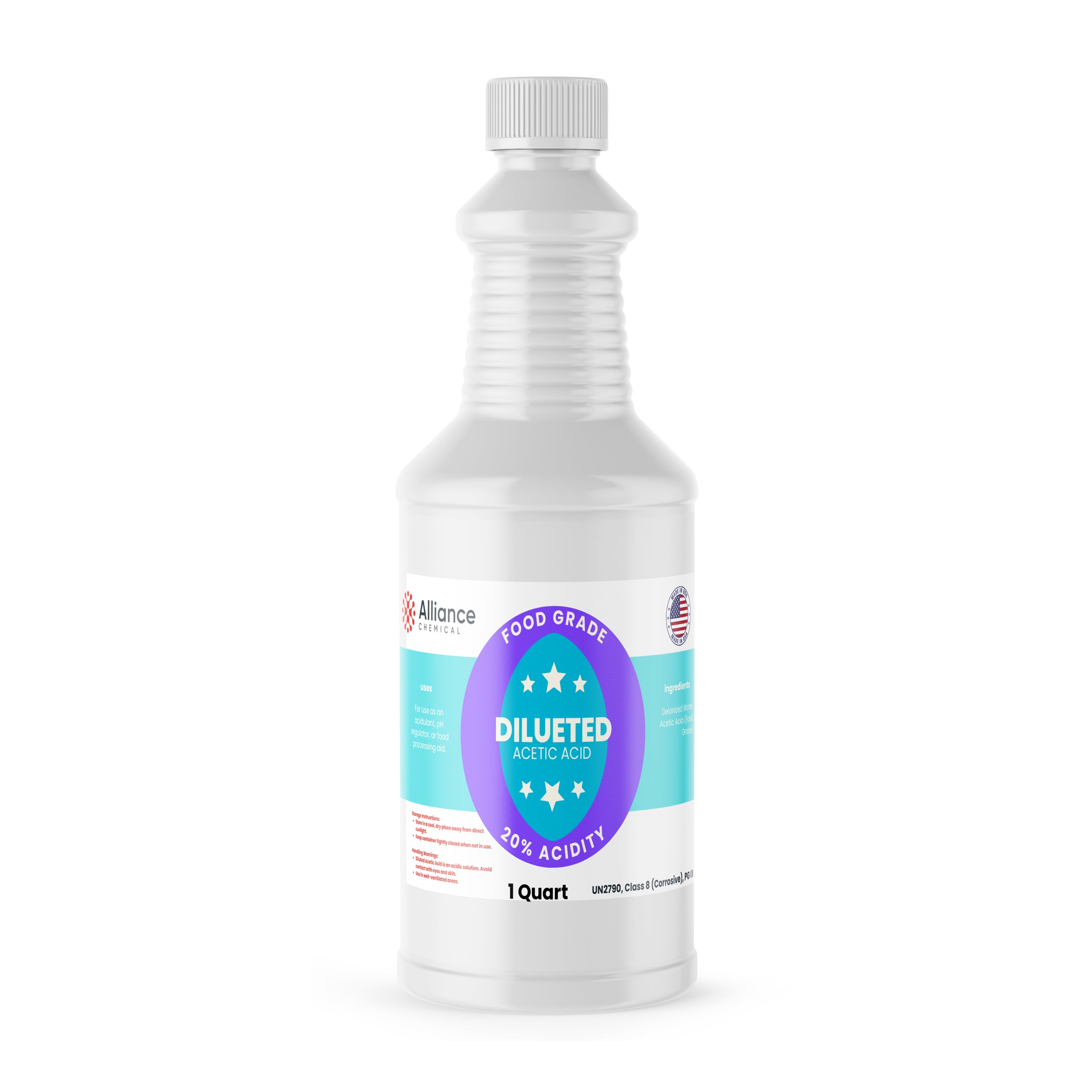
Why 20% Diluted Acetic Acid Food Grade
20% Diluted Acetic Acid Food Grade delivers a precisely measured, ready-to-deploy organic acid that eliminates the severe handling hazards, freezing risks, and exothermic reactions inherent to diluting glacial acetic acid on the facility floor. Meeting strict regulatory requirements for direct food contact, this exact concentration serves as a predictable acidulant and pH control agent across large-scale commercial food processing environments. The 20% dilution level provides sufficient active acidity to drive essential chemical reactions while minimizing the fuming and specialized ventilation requirements of higher concentrations. Facility managers rely on this standardized dilution to maintain batch-to-batch consistency in flavor profiling, acidity management, and equipment maintenance without the labor-intensive step of in-house blending. By utilizing a pre-diluted format, commercial manufacturers reduce batching errors and ensure that the exact titratable acidity is introduced into every production run.
Best Applications for This Grade
-
Commercial Condiment Formulation: commonly applied in the continuous production of dressings, sauces, mayonnaise, and marinades, providing strict pH adjustment to ensure shelf stability, manage target acidity levels, and maintain consistent tartness profiles across production batches.
-
Industrial Pickling and Canning: commonly applied in vegetable processing facilities as the primary acidifying agent, lowering the pH of the brine below the critical 4.6 threshold to maintain required acidity levels and preserve cellular texture.
-
Food-Contact Equipment Descaling: commonly applied in closed-loop CIP (Clean-In-Place) systems to dissolve calcium, magnesium, and other hard mineral scales from stainless steel dairy, brewing, and beverage lines without pitting the underlying metal surfaces.
-
Commercial Baking Operations: commonly applied in dough conditioning and leavening processes, reacting predictably with sodium bicarbonate and other baking sodas to control volumetric gas expansion, regulate crumb structure, and influence final moisture retention.
-
Meat and Poultry Processing: commonly applied in carcass wash applications as an organic acid rinse, rapidly lowering the surface pH to manage target acidulation during primary slaughter and processing stages.
When to Choose a Different Grade
- If the manufacturing formulation requires an entirely anhydrous chemical environment and strictly cannot tolerate the 80% water content introduced by this pre-mixed aqueous solution, an undiluted glacial acetic acid concentration must be selected to maintain the correct solvent balance.
- If the industrial operation involves heavy metal passivation, aggressive equipment etching, or wastewater pH reduction requiring a strong oxidizing mineral acid rather than a weak organic acidulant, Nitric Acid 20% provides the necessary chemical properties.
- If the specific food or beverage formulation demands a different tartness profile, flavor masking ability, or primary buffering capacity that acetic acid cannot provide, alternative organic food-grade acids like citric acid or malic acid should be evaluated for the recipe.
| Molecular Weight |
60.05 |
| Formula |
C2H4O2 |
| Assay |
19-21% |
| Grade |
Food Grade |
| Form |
Liquid |
| Solubility |
Soluble in water |
| Appearance |
Clear, colorless liquid |
| Boiling Point |
100 |
| Specific Gravity |
1.05 |
| Industry |
Food Processing, Culinary, Food Manufacturing, Food Service, Beverage Production |