



You wipe down the counter, and twenty minutes later the trail is back — a thin black line marching from a crack in the baseboard to a single crumb. Sprays kill the ants you can see and do nothing to the thousands you cannot. Boric acid does the opposite: it lets the ants live just long enough to carry the poison home.
That patience is the entire trick, and it is why a $20 bag of boric acid powder out-performs the spray under your sink. Here is exactly how it works, the bait recipe that actually clears a colony, how it differs from borax, and how to use it without putting pets or kids at risk.
How borates affect ants — and why the slow action matters

Published work describes borates as a slow-acting stomach toxicant in ants that also abrades the waxy coating on the exoskeleton, increasing water loss. An ant that eats enough boric acid stops being able to digest food and loses water through its damaged shell, and within a day or two it dies. On its own that would only affect the few foragers that encounter the bait — which is why the speed matters more than the poison.
Ants share food. A forager that finds your sweet bait does not eat it and stay put; it fills a special second stomach called the crop, walks back to the nest, and regurgitates droplets to feed other workers, the brood, and the queen. Biologists call this mouth-to-mouth feeding trophallaxis, and it is the supply chain that keeps an ant colony alive. Boric acid hijacks it. Because the dose is low and the ant does not die for a day or more, that one forager turns into a courier — delivering poison to hundreds of nestmates it will never see die.
A weak, slow bait clears a colony; a strong, fast one does not. Kill the forager before it makes it home and you have killed one ant. Let it live long enough to feed the nest and you have dosed the queen. That is the single fact most DIY ant baits get wrong.
This is also why spraying visible ants is a losing game. The ants on your counter are a tiny, disposable foraging crew; the colony — and the egg-laying queen who rebuilds it — is hidden in a wall void, under a slab, or out in the yard. Kill the foragers and the queen simply sends more. Boric acid bait reaches the part of the colony a spray can never touch.
Boric acid vs borax for ants: what is the difference?
Boric acid and borax are close chemical cousins, and for ant baits they work the same way — both deliver boron, which is what poisons the insect. They are not, however, the same compound, and the confusion costs people money and results.
| Boric acid | Borax | |
|---|---|---|
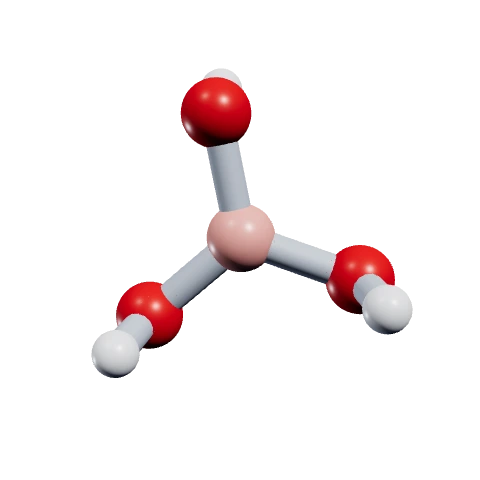
| Formula | H3BO3 | Na2B4O7·10H2O (sodium tetraborate) |
| What it is | A pure, fine acidic powder | A coarser sodium-borate salt (the laundry-aisle box) |
| Boron content | Higher per gram — more concentrated | Lower per gram (diluted by sodium and water) |
| Texture in bait | Dissolves cleanly into sweet liquid | Grittier; can settle out |
| Ant-bait result | Slightly stronger and smoother per measure | Works, but you typically use a bit more |
Chemically, borax and boric acid interconvert: dissolve borax in water and some of it becomes boric acid, and the ant’s own gut chemistry blurs the line further. So if a recipe calls for one and you only have the other, you can substitute — just remember boric acid is the more concentrated of the two, so use a little less of it. For a clean-dissolving liquid bait, boric acid powder is the easier ingredient to work with.
“Is borax the same as boric acid?” — No. Borax is sodium tetraborate; boric acid is H3BO3. Both are borate sources, but boric acid is purer, finer and more concentrated than borax. (Curious how boric acid stacks up against other acids? See our boric acid vs citric acid and boric acid vs oxalic acid comparisons.)
What kinds of ants does boric acid work on?
Boric acid bait works on the common household ants that forage indoors and share food — which is most of them — but a few species need a different plan. Knowing which one you have saves weeks of frustration.
| Ant type | Boric acid bait? | What to know |
|---|---|---|
| Odorous house ants (smell like coconut when crushed) | Yes — ideal | Classic sugar-feeders; the sweet liquid bait clears them well. |
| Argentine ants | Yes | Form huge multi-queen super-colonies — be patient and use multiple stations. |
| Pavement ants | Yes | Take both sweet and greasy baits; offer both if needed. |
| Carpenter ants | Partly | They tunnel wood rather than eat it; bait helps but you must also find and address the nest and any moisture/wood damage. |
| Fire ants (outdoors) | Limited | Aggressive outdoor mound-builders; boric acid bait is not the right tool — use a dedicated outdoor mound treatment. |
The rule of thumb: if the ants are walking your counters and feeding on crumbs and spills, they are sharing food and boric acid bait will reach the colony. If they are building mounds in the yard or hollowing out a windowsill, baiting alone is not enough — you also have to deal with the nest itself.
Which boric acid should you buy — and why bulk wins
For ant bait you do not need laboratory purity; you need clean, fine boric acid powder that dissolves without grit. Both of our grades do that — the difference is certification and price.
| Boric Acid (Technical Grade) | Boric Acid Powder 99% ACS Grade | |
|---|---|---|
| Best for | Ant & pest baits, cleaning, general household and industrial use | Lab work, buffer solutions, analytical and high-purity needs |
| Purity | High-purity industrial grade | Meets ACS analytical specifications |
| For bait, you want | This one — the value pick | Overkill for ants, but available if you also need reagent grade |
| Pack sizes | 2 lb, 5 lb, 50 lb (and bulk) | 2 lb, 5 lb, 50 lb (and bulk) |
A single bait batch uses about ½ teaspoon (~2.5 g) of boric acid. A 2 lb bag is roughly 900 grams — about 360 batches, or years of ant control, for the price of a couple of disposable bait packs. Buy the powder once; mix bait whenever a trail shows up.
If you run a property, a commercial kitchen, or a pest-control route, the 50 lb bag (and bulk pricing) brings the cost per batch to almost nothing — and every order ships with an SDS, with the Certificate of Analysis on request at no charge, so you know exactly what you are getting. Not sure which grade fits your use? Tell us the application and we will spec it for you.
How to keep ants from coming back after the colony dies
Killing the colony solves today’s problem; closing the door keeps it solved. Ants invade for two reasons — food and water — and a new colony will happily move into a home that still offers both. Once your bait has done its work, a few habits make the win permanent.
- Erase the scent trails. Foragers lay invisible chemical trails for the rest of the colony to follow. Wipe baseboards, counters, and entry points with soapy water or a vinegar solution to break the trail so the next scout cannot retrace it.
- Cut off the food. Store sugar, honey, and pet food in sealed containers, wipe up spills and crumbs the same day, and take out sweet trash promptly. A kitchen with nothing to forage is a kitchen ants leave.
- Fix the water. Repair drips under the sink, dry the shower and pet bowls, and clear standing water. Many indoor ants are really after moisture, especially in summer.
- Seal the entry points. Caulk the cracks around windows, doors, pipes, and the baseboard gaps where you saw the trail. Trim shrubs and branches that touch the house and give ants a bridge inside.
- Keep bait on standby. Because one bag of boric acid lasts for years, you can mix a fresh station the moment a new scout appears — before it becomes a trail. Catching the first forager is far easier than clearing a colony.
Ants are seasonal and persistent; the goal is not a sterile house but a boring one. Remove the food, the water, and the trail, and the few scouts that wander in find nothing worth reporting back.
Get clean, fine boric acid powder — with the paperwork
Mix years of ant bait from one bag. Technical Grade is the value pick for baits; 99% ACS Grade is on hand if you also need reagent purity. From 2 lb to 50 lb and bulk.
Frequently asked questions
How do borates affect ants?
Published work describes borates as a slow-acting stomach toxicant that also damages the exoskeleton. The slow action is why registered borate baits work at low concentrations — foragers survive long enough to share the bait in the nest. Alliance Chemical supplies boric acid as ACS-grade raw material, not as a bait product; use an EPA-registered bait and follow its label.
Is borax the same as boric acid for ants?
No. Borax is sodium tetraborate (Na2B4O7·10H2O); boric acid is H3BO3. Both are borate sources and interconvert in water, but boric acid is purer, finer and more concentrated. Neither is sold by us as a pesticide.
About the author
Andre Taki
This article is for informational purposes only.


