



A pink hydrangea and a blue hydrangea can be the same plant. Bigleaf hydrangeas carry one red-purple pigment in every flower. What turns it blue is aluminum: when the soil is acidic enough for roots to take aluminum up, it travels into the colored sepals and locks the pigment into a blue complex. Aluminum sulfate does both jobs at once. It lowers soil pH, and it delivers the aluminum.
This guide covers which hydrangeas can change color, the chemistry behind the blue, the soil pH targets university extension services publish, how much aluminum sulfate to use (by the spoon, by weight, and from a liquid alum), when to apply it, and why a hydrangea sometimes stays stubbornly pink. Where sources disagree, we show both numbers rather than picking one.
We sell aluminum sulfate as a powder, Aluminum Sulfate Hydrate ACS Grade, and as a liquid, Aluminum Sulfate 50% (Technical Grade). The buying section near the end covers which one suits a garden and which suits a nursery.
Last reviewed 16 October 2026 against the sources cited below. This is a practical gardening chemistry guide, not medical, legal or regulatory advice. How we researched it is set out at the end.

Does aluminum sulfate make hydrangeas blue?
Yes. Aluminum sulfate makes bigleaf and mountain hydrangeas bloom blue because it lowers soil pH and supplies the aluminum the flowers need for blue color. University of Georgia Extension puts it plainly: when the soil is acid, at pH 5.5 or lower, “aluminum is generally more available to the roots,” and if aluminum is present in the plant, the color is blue.
Most garden soils already contain plenty of aluminum. UMass Extension notes that “most soils have enough aluminum, but the aluminum is not available to the plant if the soil pH is high.” So there are two ways to get blue. You can make the soil acidic enough that the aluminum already there becomes soluble, or you can add soluble aluminum directly. Aluminum sulfate does both, which is why it works faster than elemental sulfur, which only acidifies.
The catch is that it only works on the right plant, and only if nothing else in the soil is locking the aluminum away again. Those two conditions explain almost every “it didn’t work” story.
Which hydrangeas can change color?
Only bigleaf hydrangea (Hydrangea macrophylla), including both mophead and lacecap forms, and mountain hydrangea (Hydrangea serrata) change color with soil chemistry. UMass Extension states that “only bigleaf (Hydrangea macrophylla) or mountain hydrangea (Hydrangea serrata) flowers will turn blue,” and Oregon State, Mississippi State and the Royal Horticultural Society say the same.
| Hydrangea | Responds to aluminum sulfate? | What you see |
|---|---|---|
| Bigleaf, mophead and lacecap (H. macrophylla), pink or blue cultivars | Yes | Blue in acid soil, mauve in between, pink in neutral to alkaline soil |
| Mountain (H. serrata) | Yes | Same pattern as bigleaf |
| White-flowered bigleaf cultivars | No | Stay white; the New York Botanical Garden says white or cream types “cannot be persuaded to provide blue flowers” |
| Panicle (H. paniculata, e.g. ‘Limelight’) | No | White or lime flowers that may age to pink; that pinking is aging, not pH |
| Oakleaf (H. quercifolia) | No | White flowers; some cultivars age to pink |
| Smooth (H. arborescens, e.g. ‘Annabelle’) | No | White to pale green |
Even within bigleaf hydrangeas, cultivars differ. UMass notes that some “tend to be blue, others, pink regardless of pH,” and researchers writing in Acta Horticulturae found that with the same aluminum supply “some cultivars turn deep blue while other display only a faint color.” If your plant was sold as a pink variety, expect a mauve or lavender result rather than a sapphire one.
Why does aluminum turn hydrangeas blue?
Aluminum turns hydrangeas blue by binding the flower’s red pigment and a colorless co-pigment into a single blue metal complex. A research group at Nagoya University led by Kumi Yoshida and Tadao Kondo spent two decades working this out, and their findings are unusually precise.
First, every hydrangea color uses the same pigment. Yoshida’s group reported in 2003 that “all colored sepals contain the same anthocyanin, delphinidin 3-glucoside.” Pink and blue are not different pigments. They are the same molecule in a different chemical setting. (The showy “petals” of a hydrangea are botanically sepals, and only the second layer of cells in them carries pigment.)
Second, blue cells hold far more aluminum. Measured directly, the vacuoles of blue sepal cells contained about 15 millimoles of aluminum per liter, against about 0.5 in red cells, a thirty-fold difference. Expressed against the pigment, blue cells held 1.2 equivalents of aluminum per molecule of anthocyanin; red cells held 0.03.
Aluminum in hydrangea sepal cell vacuoles (mM)
Source: Negishi et al., PLoS One (2012), measured in single sepal cells. Bar lengths to scale.
Third, aluminum alone is not enough. The blue requires a co-pigment from a family called 5-O-acylquinic acids, the best known being 5-O-caffeoylquinic acid (chlorogenic acid). Ito and colleagues found that “for blue coloration, both 5-O-acylquinic acids and Al(3+) were essential.” Mass spectrometry later fixed the recipe: the “hydrangea-blue complex” is pigment, aluminum and co-pigment “in a ratio of 1:1:1.” Swap the co-pigment for a near-identical isomer, 3-O-caffeoylquinic acid, and the mixture “did not give any blue color but instead was purple.”
Fourth, the cell’s acidity shifts with it. The vacuolar pH of blue cells was 4.1, against 3.3 in red cells. And a purple hydrangea turns out to be a mosaic: a 2021 study in New Phytologist found that “the purple color is a color mosaic” of bluer and redder cells, and that “the bluer the cell, the greater the ratio of 5-O-acylquinic acids and Al3+ to anthocyanins.”
The short version: red pigment + aluminum + co-pigment, one of each, makes blue. Your job as a gardener is the middle ingredient. The plant supplies the other two.
What soil pH makes hydrangeas blue, purple or pink?
Blue hydrangeas need acidic soil, around pH 5.0 to 5.5; pink hydrangeas need soil around pH 6.0 to 6.5 or higher; in between, flowers come out purple or mixed. Extension services agree on the shape of that curve but put the boundaries in slightly different places, so read the numbers as ranges, not switches.
| Source | Blue | Purple / mixed | Pink |
|---|---|---|---|
| UMass Amherst Extension | below 5.5 | 5.5–6.5 | above 6.5 |
| Mississippi State Extension | 5.0–5.5 | 5.5–6.0 | 6.0–6.5 |
| Clemson HGIC | 5.0–5.5 | — | 6.0 and up |
| University of Maryland Extension | 5.0–5.5 | in between | 6.0–6.5 |
| Oregon State Extension | 5.5 or lower | 5.5–6.5 | 6.5 or higher |

Two practical points follow. First, test before you add anything. Clemson’s advice is to “always test your soil before applying sulfur or lime to avoid over-correction,” and UMass warns that the exact amount needed “will vary depending on current soil pH and soil type.” A soil already at pH 5.3 needs little or no aluminum sulfate; a soil at 7.2 may never hold blue in the ground at all. Second, aim for the middle of the blue band, not the bottom. Pushing soil far below pH 5 does not make a bluer flower, and it raises the risk of root injury (see the safety section).
How much aluminum sulfate per gallon for hydrangeas?
The standard rate is 1 tablespoon of aluminum sulfate dissolved in 1 gallon of water, poured around the base of the plant. University of Georgia, Virginia Cooperative Extension, Mississippi State and the Hamilton College Arboretum all give that rate. The New York Botanical Garden gives a weight instead: half an ounce per gallon, about 14 grams, for plants at least two to three years old.
Bluing drench for one established hydrangea
- 1 level tablespoon of aluminum sulfate powder, or ½ oz (about 14 g) if you prefer to weigh it (the New York Botanical Garden’s rate)
- 1 gallon of water, stirred until fully dissolved
- ½ to 2 gallons of the solution per plant, depending on plant size (Hamilton College Arboretum)
- Water the plant well first, then pour the solution on the soil around the base, not on the leaves or stems
Repeat in March, April and May (University of Georgia). Do not exceed the rate: UMass warns that “too much aluminum sulfate will injure plants.”
One handout from a University of California program gives a much stronger rate, a quarter cup per gallon applied weekly. That is roughly four times the concentration in every other source we found, and it conflicts with the root-injury warnings from Maryland and Illinois. We would not start there.
Using liquid alum instead of powder
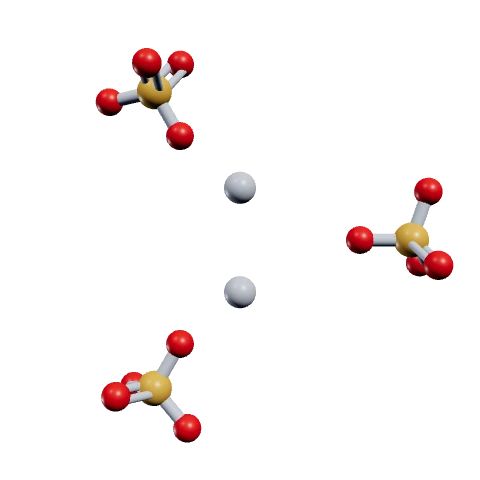
If you are working from a liquid aluminum sulfate, the dose is a matter of matching the aluminum, and the arithmetic is short. Our ACS powder is the 18-hydrate, Al2(SO4)3·18H2O, molar mass 666.4 g/mol, which is 8.1% aluminum by weight. So 14 g of it carries about 1.15 g of aluminum.
Standard commercial liquid alum is sold at about 48% strength, measured as dry 14-hydrate alum, and published technical data sheets put it at roughly 4.0 to 4.5% aluminum with a specific gravity near 1.33. That works out to about 0.057 g of aluminum per milliliter. To deliver the same 1.15 g of aluminum:
1.15 g Al ÷ 0.057 g Al/mL ≈ 20 mL of liquid alum per gallon (about 4 teaspoons)
Check the technical data sheet for your lot before you scale this up, because liquid alum strength is specified as a range. For a nursery running hundreds of pots, the liquid is the simpler product: it meters straight into an injector with no dissolving step. Commercial growers often apply four weekly drenches, according to a 2019 North Carolina State study in Acta Horticulturae.
| Form | Aluminum by weight | Amount per gallon for ~1.15 g Al |
|---|---|---|
| Aluminum sulfate 18-hydrate powder (our ACS Grade) | 8.1% | ~14 g (½ oz, the NYBG rate) |
| Aluminum sulfate 14-hydrate powder (common garden form) | 9.1% | ~13 g |
| Liquid alum, ~48% as dry alum, SG ~1.33 | ~4.0–4.5% | ~20 mL (4 tsp) |
Aluminum percentages are our arithmetic from PubChem molar masses (aluminum 26.98 g/mol) and published liquid alum specifications.
When should you apply aluminum sulfate to hydrangeas?
Apply aluminum sulfate drenches in spring, as new growth emerges and before flower buds color, and use autumn to prepare the soil. The extension timetable is consistent: University of Georgia and Virginia Cooperative Extension give “March, April and May,” Clemson says to act “when new growth emerges in April,” and a University of California handout warns that “all treatments must be started well ahead of the blooming period.” Spraying a plant that is already in bloom will not repaint this year’s flowers.
Autumn matters because soil pH changes slowly. Virginia Cooperative Extension advises adding lime or sulfur “in autumn, based on your soil test results for the desired pink or blue blooms the following summer,” and notes the change can take up to six months. Oregon State goes further: “Amendments are best added in fall, and color changes may take several years.”
So if you are reading this in October, here is a realistic plan:
- October–November: test the soil. If it is well above pH 6, broadcast elemental sulfur at the extension rate (University of Georgia: half a cup of wettable sulfur per 10 square feet) and water it in. Switch to a low-phosphorus fertilizer for next season.
- Winter: leave it alone. Sulfur works slowly (Hamilton College Arboretum), which is exactly why it goes on months ahead.
- March, April and May: apply the aluminum sulfate drench once a month, as new growth emerges, watering first.
- Summer: judge the color. Retest the soil in late summer and adjust for the following year.
Expect the first season to give a partial shift, often to purple, with a deeper blue the year after. The University of Georgia notes it can take a year to see a noticeable change from soil amendments, and describes the aluminum sulfate drench as the quicker route.
Why are my hydrangeas still pink?
Hydrangeas usually stay pink after bluing for one of five reasons: the plant cannot turn blue, the soil is still too alkaline, phosphorus is tying up the aluminum, alkaline water or concrete is pushing the pH back up, or the treatment started too late in the season.
- Wrong plant. Panicle, oakleaf, smooth and white bigleaf hydrangeas do not change color, and some bigleaf cultivars lean pink whatever you do.
- Phosphorus. UMass explains that “phosphorus in the soil tends to bind aluminum so that it isn’t readily available for the plant,” and recommends a fertilizer low in the middle number, such as 12-4-8. The New York Botanical Garden adds that superphosphates and bone meal should be avoided when you want blue.
- Hard or alkaline water. Oregon State notes that “high-alkalinity water can raise soil pH,” and the Hamilton College Arboretum warns that municipal suppliers may buffer their water upward. A hydrangea watered all summer from a hose can drift back toward pink.
- Concrete. Foundations and walkways leach lime. A hydrangea planted against a concrete foundation is fighting a slow, steady supply of alkali.
- Timing. A drench applied in July acts on next year’s flowers, not this year’s.
If your garden soil is strongly alkaline, the most reliable fix is a container. The New York Botanical Garden notes that a bed can be hard to keep “constantly acidic and aluminum-rich,” and that “this problem can be avoided by growing the shrubs in containers, where the conditions can be more easily controlled.” The RHS suggests large containers of ericaceous (lime-free) compost on alkaline soils, and Oregon State specifically recommends aluminum sulfate for potted plants in soilless mix.
Is alum the same as aluminum sulfate?
Not always. In gardening and water treatment, “alum” usually means aluminum sulfate, Al2(SO4)3; the University of Georgia writes “alum (aluminum sulfate)” in its hydrangea guidance. But the alum sold in the grocery spice aisle is a different compound: potassium alum, KAl(SO4)2·12H2O, molar mass 474.4 g/mol.
The difference matters for dosing. By our arithmetic from PubChem molar masses, potassium alum is about 5.7% aluminum by weight, against 8.1% for aluminum sulfate 18-hydrate and 9.1% for the 14-hydrate. We found no university or peer-reviewed source that gives a hydrangea rate for potassium alum. Every extension rate in this guide is written for aluminum sulfate, so use aluminum sulfate if you want the published numbers to apply.
How do you make hydrangeas pink instead?
To make bigleaf hydrangeas pink, raise the soil pH to about 6.0 to 6.5 with lime so that aluminum stays locked up. University of Georgia, Virginia Cooperative Extension and Mississippi State all give the same broadcast rate, one cup of dolomitic lime per 10 square feet, watered in. The Hamilton College Arboretum suggests half to one cup per plant in the fall, targeting pH 6.0 to 6.3.
Do not overshoot. UMass warns that “too much lime can cause new growth to yellow due to lack of iron,” and the Hamilton College Arboretum cautions that it may take a couple of years to “sweeten” a strongly acidic soil. Aluminum sulfate has no role in going pink; it pushes the other way.
Is aluminum sulfate safe to handle?
Aluminum sulfate is an acidic salt that can cause serious eye damage, so wear safety glasses and gloves when measuring it or mixing a drench. PubChem’s aggregated GHS classification lists hazard statement H318, “Causes serious eye damage,” with the signal word Danger, and a 5% solution has a pH of about 2.9.
Handling: add the powder to water, stir until dissolved, and keep the dust out of your eyes. Rinse any splash off skin with plenty of water. Keep the dry product sealed, labeled and away from children and pets. Store liquid alum in its original container; it is acidic and the technical data sheets note it can corrode some metals.
For the plant, the risk is too much, not too little. The University of Maryland warns that too much aluminum sulfate “can damage or burn roots,” and the University of Illinois calls sulfur “a safer bet” for general acidifying because it “reduces the chance of aluminum toxicity.” A 2022 study of container-grown hydrangeas in Horticulturae found that aluminum sulfate drove the root zone below pH 4, harmed root development, and that no plants produced the deep blue consumers want. The University of Georgia adds: “Avoid getting the solution on the leaves because foliar damage may result.”
More is not bluer. Stick to the published rate, water the plant before every drench, keep the solution off leaves and stems, and retest the soil once a year. If the soil is already in the blue range, stop adding aluminum sulfate.
Which aluminum sulfate should you buy for hydrangeas?
For a home garden, buy aluminum sulfate powder in a small jar; for a nursery or landscape crew treating many plants, liquid alum is easier to meter. We carry both.
| Product | Form | Pack sizes | Best fit |
|---|---|---|---|
| Aluminum Sulfate Hydrate ACS Grade | White crystalline powder, 18-hydrate | 2 lb jar to 50 lb bag | Home gardens: weigh 14 g per gallon. A 2 lb jar makes roughly 65 one-gallon drenches. |
| Aluminum Sulfate 50% (Technical Grade) | Clear liquid, specific gravity about 1.33 | 1 quart to 330 gallon tote | Nurseries and growers dosing through an injector; about 20 mL per gallon by the arithmetic above |
ACS Grade means the powder meets American Chemical Society reagent specifications. A hydrangea does not need reagent purity. What it does give a gardener is a known composition, so the weight-based dose above is the dose you actually apply. A certificate of analysis is available on request. The liquid ships as a regulated corrosive (Packing Group III).
How we researched this
We read the sources below on 16 October 2026: hydrangea guidance from University of Georgia, Virginia Cooperative Extension, UMass Amherst, Mississippi State, Clemson, the University of Maryland, the University of Illinois and Oregon State extension services, the Royal Horticultural Society and the New York Botanical Garden; the peer-reviewed sepal chemistry papers from Kumi Yoshida’s group; horticultural research on aluminum drenches; PubChem for hazards and molar masses; and published liquid alum specifications. Where sources disagree, as on pH boundaries and drench strength, we report the range. The aluminum percentages and the liquid alum conversion are our own arithmetic and are shown in full. Product names, forms and pack sizes come from our live catalog. The photographs in this article are illustrations, not test results.
Sources
- Growing Bigleaf Hydrangea (Circular 973), University of Georgia Extension
- Pruning Hydrangeas, Virginia Cooperative Extension
- Growing Tips for Hydrangeas: Color, Fertilizing, UMass Amherst Extension
- How to Change the Color of Hydrangeas, Mississippi State University Extension
- Hydrangea Care in South Carolina (HGIC 1067), Clemson Cooperative Extension
- Hydrangea: Identify and Manage Problems, University of Maryland Extension
- Hydrangeas, University of Illinois Extension
- Hydrangeas bring beauty and variety to Oregon gardens, Oregon State University Extension
- Shrubby hydrangeas, Royal Horticultural Society
- How can I make my hydrangeas blue?, New York Botanical Garden, Mertz Library
- Yoshida K. et al., Sepal color variation of Hydrangea macrophylla and vacuolar pH measured with a proton-selective microelectrode, Plant Cell Physiology (2003)
- Ito D. et al., Chemical studies on different color development in blue- and red-colored sepal cells of Hydrangea macrophylla, Bioscience, Biotechnology, and Biochemistry (2009)
- Negishi T. et al., Tonoplast- and plasma membrane-localized aquaporin-family transporters in blue hydrangea sepals of aluminum hyperaccumulating plant, PLoS One (2012)
- Ito T., Oyama K., Yoshida K., Direct Observation of Hydrangea Blue-Complex Composed of 3-O-Glucosyldelphinidin, Al(3+) and 5-O-Acylquinic Acid by ESI-Mass Spectrometry, Molecules (2018)
- Yoshida K. et al., Single-cell analysis clarifies mosaic color development in purple hydrangea sepal, New Phytologist (2021)
- Roman H. et al., Effect of different Al supplies during vegetative phase on sepal blueing in hydrangea inflorescence, Acta Horticulturae 1375 (2023)
- Landis H. et al., Incorporating slow release coated polymer aluminum sulfate into the substrate to produce blue hydrangeas, Acta Horticulturae 1266 (2019)
- Pietsch et al., A Fine Line between Phytotoxicity and Blue When Producing Hydrangea macrophylla in a Nursery at a Low Substrate pH, Horticulturae 8(8):690 (2022)
- Aluminum sulfate (CID 24850), PubChem, National Library of Medicine
- Potassium alum dodecahydrate (CID 62667), PubChem, National Library of Medicine
- Liquid aluminium sulphate 48% technical data sheet (Brenntag), RFQ 5330 addendum, Resort Municipality of Whistler
Frequently asked questions
How long does it take aluminum sulfate to turn hydrangeas blue?
Expect at least one season. Drenches in March, April and May affect that summer's flowers, often shifting them toward purple first; a full blue usually takes until the following year, and strongly alkaline soils can take several years.
Can I use aluminum sulfate in the fall?
Use fall to test the soil and, if needed, add elemental sulfur so it has months to work. Extension services time aluminum sulfate drenches for spring, as new growth emerges, so the aluminum is available while next season's flowers develop.
How often should I apply aluminum sulfate to hydrangeas?
Once a month for three months in spring is the common extension schedule (March, April and May). Retest the soil each year and skip the drenches if the pH is already in the blue range.
Can I sprinkle aluminum sulfate dry around hydrangeas?
You can, but a dissolved drench is gentler. The Hamilton College Arboretum notes it "can be applied 'dry' but 'safer' as a drench," at 1 tablespoon per gallon. Keep granules off the stems and water in thoroughly.
Will aluminum sulfate turn white hydrangeas blue?
No. White-flowered hydrangeas lack the color response, and panicle, oakleaf and smooth hydrangeas do not change with soil pH either. Only bigleaf and mountain hydrangeas with pink or blue flowers respond.
Can I use spice-aisle alum on hydrangeas?
Spice-aisle alum is potassium alum, a different compound with less aluminum per gram than aluminum sulfate. No university source we found gives a hydrangea rate for it, so the published rates in this guide do not apply to it.
Why are my blue hydrangeas turning pink?
The soil pH has probably drifted up. Common causes are alkaline tap water, lime leaching from nearby concrete, and a high-phosphorus fertilizer that binds aluminum. Test the soil and switch to a low-phosphorus fertilizer.
What fertilizer should I use for blue hydrangeas?
Use one low in phosphorus, the middle number on the bag. UMass Extension suggests something like 12-4-8, because phosphorus binds aluminum in the soil; the New York Botanical Garden says to avoid superphosphate and bone meal when you want blue.
Can aluminum sulfate harm my hydrangea?
Yes, if overused. Too much can burn roots and drive soil pH below 4. Use the published rate of about 1 tablespoon per gallon, water first, keep it off the leaves, and stop once the soil is in the blue range.
Do container hydrangeas need less aluminum sulfate?
Containers are easier to keep blue, but it is also easier to overdo it there. A 2022 nursery study found repeated aluminum sulfate pushed container substrate below pH 4 and harmed roots. Use the standard drench rate, test the mix, and stop once it reads in the blue range.
About the author
Andre Taki
This article is for informational purposes only.


