

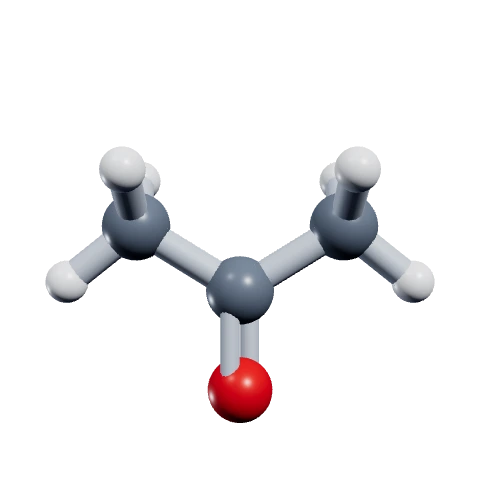


Carbon fiber is having its moment. It is in the EV battery enclosures and body panels engineered to claw back range, the ever-longer wind-turbine blades, the airframes of every new aircraft and electric air taxi, and the Type-IV tanks that hold hydrogen at 700 bar. None of those parts get built — or repaired, or one day recycled — without a humble, fast-evaporating solvent doing the unglamorous work in the background: acetone.
Acetone will never be the headline of a composites press release. But walk any layup shop, aerospace MRO hangar, or pilot-scale recycling line and you will find it in squeeze bottles, wipe stations, and ultrasonic baths. This guide is about that role — what acetone actually does in carbon-fiber and composite manufacturing, what it does not do (an important honesty point), whether it can damage the parts, which grade a shop should buy, and how to handle a solvent whose vapors ignite below room temperature.
If you want the broader picture of acetone as an industrial solvent before the composites deep-dive, our Decoding Acetone primer and ACS-grade acetone guide cover the chemistry and grade basics. This article goes specifically into the composites bay.
What is acetone used for in carbon fiber and composite manufacturing?
Before ordering, compare technical and ACS acetone grades and packaging. Match the documented specification to your procedure; a grade label alone does not establish suitability.
In composite manufacturing, acetone is the general-purpose preparation, cleanup, and surface-prep solvent — it readies tools and surfaces before resin goes on, and it cleans up the resin afterward. It earns that role through a simple combination of traits: it dissolves uncured thermoset resins and a wide range of oils, greases, and mold-release residues; it is fully miscible with water; it evaporates very fast and leaves little residue when the grade is clean; and it is cheap enough to use in volume. Across a build, that translates into four distinct jobs.
1. Mold and tooling prep. Before a part is laid up, molds are degreased and stripped of old release agent so the new release layer bonds correctly — acetone is the standard wipe-down for that. 2. Surface prep before bonding and painting. Cured laminates are solvent-wiped to remove mold release, fingerprints, and oils so adhesives and coatings actually stick — a make-or-break step for structural bonds. 3. Wet-layup and tool cleanup. Brushes, rollers, squeegees, mixing pots, and spills of uncured epoxy, vinyl-ester, and polyester resin are cleaned with acetone before they cure solid. 4. Emerging fiber recycling. Solvent-based (solvolysis) processes use acetone and other solvents to break down cured resin and recover the valuable carbon fiber from scrap and end-of-life parts.
CAS: 67-64-1 • Formula: C3H6O / (CH3)2CO • Molar mass: 58.08 g/mol • Boiling point: 56 °C • Flash point: ~−20 °C (closed cup), Class IB flammable • fully water-miscible. Properties: PubChem CID 180.
Notice what is not on that list: making the fiber. That distinction matters enough to spell out, because it is the most common misconception about acetone and carbon fiber — and it is the subject of the next two sections.
Does acetone make carbon fiber? No — here is what actually does
Acetone plays no part in producing the carbon fiber itself; it is a fabrication and finishing solvent, not a precursor chemistry. The fiber is made from a polymer precursor — overwhelmingly polyacrylonitrile (PAN), with pitch- and rayon-based fibers in niche roles. That precursor is spun into fine filaments, then run through a high-temperature thermal sequence that converts it to nearly pure carbon.
- Polymerize and spin the PAN precursor. Acrylonitrile is polymerized and dissolved into a spinning dope — using polar solvents such as DMSO, DMF, or aqueous sodium thiocyanate, not acetone — then wet- or dry-jet spun into white precursor filaments.
- Oxidative stabilization. The filaments are held under tension in air at roughly 200–300 °C, cross-linking the polymer so it will not melt in the next step.
- Carbonization. In an inert atmosphere at roughly 1,000–1,500 °C (and higher for high-modulus grades), almost everything but carbon is driven off, leaving fibers that are about 90%+ carbon.
- Surface treatment and sizing. The fiber surface is treated and coated with a thin size to protect it and help it bond to the resin matrix — then it is wound onto spools as tow.
So when acetone meets carbon fiber, the fiber already exists. Acetone’s entire relationship with carbon fiber is downstream: preparing the resin and tooling that turn that tow into a finished part, cleaning the part for bonding, and — at end of life — helping pull the fiber back out of the cured resin. Anyone telling you acetone “makes” carbon fiber has the chemistry backwards.
Does acetone damage carbon fiber? What it touches and what it doesn’t
Acetone does not damage cured carbon fiber itself — the carbon filaments are chemically inert to it — but it can attack the resin matrix and certain plastics around the fiber, and that is where caution is needed. Understanding the difference between the fiber and everything around it is the key to using acetone safely on a finished part.
| Material | Acetone effect | Practical takeaway |
|---|---|---|
| Cured carbon fiber filament | Inert — no attack | Safe to wipe a fully cured CFRP surface |
| Fully cured epoxy matrix | Highly resistant | Brief solvent wipe is standard practice |
| Uncured / partially cured resin | Dissolves it | Exactly why it cleans tools — keep off green parts |
| Thermoplastic matrices & some gel coats | Can soften / craze | Spot-test; some thermoplastics are vulnerable |
| Foam cores, some adhesives, decals | Can attack | Mask and avoid pooling on sandwich cores |
The headline is reassuring: a quick acetone wipe on a fully cured epoxy/carbon laminate is routine and safe, which is why solvent-wipe surface prep is written into countless shop and aerospace process steps. The cautions are about everything else. Acetone readily dissolves uncured resin (its cleanup superpower, but a hazard if you flood a green laminate that has not finished curing), and it can soften or craze some thermoplastic composite matrices, certain gel coats, foam cores, and adhesives. The rule of thumb: inert to the fiber, hard on the wrong polymer. When in doubt on an unfamiliar matrix or repair, spot-test in a hidden area first, and never let acetone pool on a sandwich-core part where it can wick into the core.
Can you use acetone on a finished carbon fiber part, like a bike frame or a clear-coated panel?
Yes for a small spot, with care: the carbon filaments will not be harmed, but the finish might. Most finished parts wear a clear coat or paint, and PubChem lists acetone as a solvent for lacquers and varnishes. A wet acetone wipe can dull or soften that top layer even when the laminate underneath is fine.
So match the solvent to the job. For routine cleaning of a finished part, mild soap and water or isopropyl alcohol does the work without testing the clear coat. Save acetone for a spot of adhesive, tape residue, CA glue or uncured resin: put a little on a lint-free cloth, wipe briefly, follow with a clean damp cloth, and try it first on a hidden area such as the inside of a stay or the back of a panel. Never soak the part or let acetone sit in a joint, a bonded insert or around rubber and plastic trim.
Can I use isopropyl alcohol to clean carbon fiber?
Yes. Isopropyl alcohol (IPA) works for routine cleaning of finished carbon fiber parts. Per the NIOSH Pocket Guide it evaporates more slowly than acetone (vapor pressure 33 mmHg vs 180 mmHg) and has a higher flash point (53 °F vs 0 °F). Neither one attacks the carbon filaments.
| Property (NIOSH Pocket Guide) | Acetone | Isopropyl alcohol |
|---|---|---|
| CAS number | 67-64-1 | 67-63-0 |
| Boiling point | 133 °F (56 °C) | 181 °F (83 °C) |
| Vapor pressure | 180 mmHg | 33 mmHg |
| Flash point | 0 °F | 53 °F |
| OSHA PEL (8-hr TWA) | 1,000 ppm | 400 ppm |
| Best composites job | Uncured resin cleanup, pre-bond wipe on cured laminate, adhesive spots | Routine cleaning of finished and clear-coated parts |
If a bonding process spec names one of them, use that one. Sources: NIOSH, acetone; NIOSH, isopropyl alcohol.
Does acetone dissolve carbon?
No. Acetone does not dissolve elemental carbon in the forms you meet in a shop: carbon fiber, graphite, soot or baked-on carbon deposits. PubChem lists elemental carbon as insoluble. When acetone seems to remove carbon buildup, it is dissolving the oil, grease, varnish or resin that holds the carbon to the surface, and the loosened carbon then wipes or brushes away.
That explains the mixed reports about acetone on engine parts and cast iron. Where the deposit is mostly oily or resinous binder, acetone lifts it well. Where it is hard, dry, heavily baked carbon, acetone has little to grab, and the work falls back on mechanical cleaning or a cleaner made for that deposit. No common solvent dissolves the carbon itself; the question is always what is holding it in place.
One caution: acetone is also a solvent for rubber and attacks many plastics (PubChem, ICSC entry), so keep it off seals, gaskets, hoses and plastic housings near the deposit. Source: PubChem, Carbon (CID 5462310).
What should you not use acetone on?
Keep acetone off painted and clear-coated finishes, lacquered or varnished surfaces, most plastics and foams, rubber seals, and acetate fabrics, unless a spot test says otherwise. PubChem describes acetone as a solvent for rubber, plastics, lacquers, varnishes and cellulose acetate, and its ICSC entry states plainly that it attacks plastics.
- Clear coats, paint, lacquer and varnish. The most common casualty on finished carbon fiber, furniture and car trim. Spot-test on a hidden area.
- Plastics and foam. Plastic trim, housings, lenses and foam cores. For a specific plastic such as polycarbonate, check the resin maker's chemical-resistance data before you wipe.
- Rubber. Seals, gaskets, hoses and rubber cement.
- Acetate fabric. Under the FTC textile rules, acetate is a fiber made of cellulose acetate, and acetone is a solvent for cellulose acetate. Rayon is regenerated cellulose, a different fiber, but dyes and finishes vary, so test a hidden seam on any fabric.
- Green laminates. Uncured or partly cured resin dissolves in acetone, which is why it cleans tools and why it must stay off a part that has not finished curing.
Sources: PubChem, Acetone (CID 180); 16 CFR 303.7, generic fiber names.
How is acetone used for composite surface prep and bonding?

For bonding and painting, acetone’s job is to leave the surface clean and contaminant-free so the adhesive or coating can form a real chemical and mechanical bond — and a bad solvent wipe is one of the most common causes of bond failure. Mold-release agent is engineered to make parts not stick to the mold; if any of it survives onto the bonding face, the adhesive will not stick either. Acetone (or, by spec, another approved solvent) removes that release residue along with oils, fingerprints, and dust.
Done right, the solvent wipe follows a disciplined two-rag method, and the details matter more than they look:
- Abrade or peel-ply first. Mechanical prep — sanding, grit-blast, or a peel-ply layer pulled just before bonding — creates the fresh, high-energy surface. The solvent wipe is a cleaning step, not a substitute for it.
- Wet a clean lint-free wipe, not the part. Apply acetone to the wipe so you are lifting contamination away, not flooding it across the surface.
- Wipe one direction, then flip to a dry wipe. Wipe contamination off with the wet cloth, then immediately dry-wipe before the acetone evaporates — otherwise the solvent flashes off and re-deposits the very contaminants it dissolved.
- Bond within the open time. A freshly prepped surface starts re-contaminating from the air immediately, so adhesive or primer goes on within the window the process spec allows.
Structural and aerospace bonding is governed by qualified process specifications that name the exact approved solvent, cleanliness verification, and timing. Acetone is a widely used and widely approved surface-prep solvent, but it is not universal — some specs call for a specific solvent (MEK and IPA are common alternates) or a particular cleanliness test. If your work is governed by an OEM, mil-spec, or AS/NAS process spec, buy and clean to that spec. For general composite, marine, automotive, and tooling prep, acetone is the default. See our industrial degreasing and surface-prep guide for the broader method.
One practical caution unique to acetone: it evaporates so fast that on a hot surface it can flash off before it has lifted the contamination, leaving a residue ring. That is why the wet-wipe-then-dry-wipe discipline matters, and why some shops prefer a slightly slower solvent on large, warm surfaces. Acetone’s speed is a feature for small parts and a thing to manage on big ones.
Why is acetone the standard cleanup solvent for epoxy and resin?
Acetone is the default shop cleanup solvent because it dissolves uncured thermoset resin fast, before it can harden into a permanent coating on your tools. Anyone who has done a wet layup knows the clock: once epoxy, vinyl-ester, or polyester resin starts to gel, brushes, rollers, squeegees, and mixing pots become disposable. Acetone buys back that equipment.
The same property drives a few related uses: wiping up resin drips and spills before they cure, cleaning spray equipment and chop-gun lines between runs, and removing uncured resin from a part edge or fixture. It is fully miscible with the resins it dissolves and with water, so it rinses clean. A note many shops learn the hard way: acetone is for cleanup and prep, not for thinning resin to lay up with. Adding acetone to a thermoset to drop its viscosity contaminates the matrix, interferes with cure, and weakens the laminate — if a resin is too thick, warm it or choose a formulated low-viscosity system, do not cut it with solvent.
Yes: clean tools, brushes, mixing pots, and spills of uncured resin; wipe prep cured surfaces. No: do not add acetone to resin to thin it for layup — it disrupts cure and degrades the finished part. The right move for high viscosity is a warmer resin or a system formulated thin, not solvent.
Because cleanup is high-volume and not residue-critical, this is the job where Technical Grade acetone shines — you are washing tools, not prepping a metrology surface. The grade question is worth its own section.
Can acetone help recycle carbon fiber? Solvolysis and the circular economy

Yes — solvent-based recycling (solvolysis) uses acetone and other solvents to dissolve the cured resin out of a composite and recover the carbon fiber, and it is one of the most promising answers to a fast-growing waste problem. Carbon fiber is expensive and energy-intensive to make, yet retired wind blades, aerospace parts, and factory offcuts have largely gone to landfill because cured thermoset composites do not melt down like metals or thermoplastics. That is changing.
Three recycling routes are maturing, and each treats the resin differently:
| Route | How it works | Fiber recovered |
|---|---|---|
| Mechanical | Grind the whole composite into filler/short fiber | Low value — chopped, not full-length |
| Pyrolysis (thermal) | Heat to burn/volatilize the resin off the fiber | Good fiber; resin is destroyed |
| Solvolysis (chemical) | Solvents (incl. acetone, sometimes near/supercritical) break resin bonds | Cleanest fiber; can also recover resin value |
Solvolysis is the route where acetone shows up. Using solvents — sometimes near- or supercritical to boost their dissolving power — the process cleaves the cured resin and frees carbon fiber with much of its original length and strength intact, and can recover usable chemicals from the resin instead of simply burning it. It is still scaling from pilot and demonstration toward commercial volume, but it points at a genuine circular economy: a chemical we already sell by the drum for layup cleanup is part of the toolkit for pulling that same fiber back out at end of life. Frame it honestly — this is emerging, not yet the dominant industrial method — but it is real, and it is moving.
What grade of acetone do composite shops need? Technical vs ACS
Most composite work runs fine on Technical Grade acetone; the ACS grade earns its premium only where leftover residue would ruin the job. Both grades are almost entirely acetone — strength is not the variable. What separates them is the ceiling on water and non-volatile residue, and whether a Certificate of Analysis is available for the batch.
| Grade | What it controls | Where it fits in composites |
|---|---|---|
| Technical Grade | High assay, looser residue/water limits, no per-lot certificate | Tool, mold, and brush cleanup; general degreasing; spill cleanup; high-volume shop use |
| ACS Grade | Tight assay, low water, low residue-on-evaporation, Certificate of Analysis on request at no charge | Final pre-bond surface prep on bond-critical parts, electronics-adjacent and optical composites, QC and analytical labs |


The deciding question is simple: does residue matter for this step? When you are washing a chop-gun or a stack of brushes, it does not — Technical Grade is the economical, correct choice. When you are doing the last wipe on a surface that is about to be structurally bonded, painted with a high-spec coating, or measured, trace non-volatile residue left behind by a dirtier solvent can be the difference between a good bond and a disbond. That is where ACS Grade and its documented low residue-on-evaporation — plus the Certificate of Analysis — pay for themselves. Many shops stock both: Technical by the drum for cleanup, ACS for the critical final wipe and the lab. For more on when purity is worth paying for, see our ACS-grade acetone guide and our guide to choosing the right industrial solvent.
Do not over-buy ACS for tool washing, and do not under-buy Technical for a bond-critical final wipe. If a process spec names a solvent purity or a specific specification (for example, acetone to ASTM D329), buy to that spec. Grade is about impurities and documentation, not strength.
Is acetone safe to use on composites? Flammability and handling
Acetone is safe and effective when handled correctly, but it demands respect for one reason above all: it is extremely flammable, with a flash point far below room temperature. Its vapors can ignite from a spark, static discharge, or hot surface under ordinary shop conditions — and a composites bay full of solvent rags, sanding dust, and resin is exactly the environment where that matters.
Class IB flammable liquid, flash point ~−20 °C (closed cup), autoignition ~465 °C, vapor heavier than air and able to travel to an ignition source. OSHA PEL: 1,000 ppm (8-hr TWA); NIOSH REL 250 ppm; IDLH 2,500 ppm. Bond and ground containers when transferring; use in ventilated areas away from ignition sources; store solvent-soaked rags in a closed metal waste can. See the NIOSH Pocket Guide for acetone and keep a current Safety Data Sheet at the point of use.
The practical controls are straightforward: ventilate (acetone vapor displaces air and is heavier than it, so it pools low), eliminate ignition sources and static, bond and ground when dispensing from drums, wear solvent-resistant gloves (nitrile degrades fast in acetone — use a suitable glove and change it), and protect your eyes. Health-wise acetone is one of the less toxic common solvents — the body even makes small amounts of it — but high vapor concentrations cause headaches, dizziness, and irritation, and repeated skin contact defats and dries the skin. The dominant hazard is the fire risk, not chronic toxicity, which is why storage and ignition control drive the handling plan. For broader solvent-handling context, see our ultimate guide to industrial solvents.
What does acetone react violently with?
Strong oxidizers, above all. NIOSH lists oxidizers and acids as incompatible with acetone. The ICSC entry in PubChem says contact with strong oxidants such as nitric acid or hydrogen peroxide generates explosive peroxides, and that acetone reacts with chloroform or bromoform under basic conditions with a fire and explosion hazard.
PubChem's laboratory incident records include one where acetone added to piranha solution (sulfuric acid and hydrogen peroxide) in a plastic waste bottle burst the bottle immediately. In a composites or lab setting that translates into three rules: never pour acetone waste into an acid or peroxide waste container, keep acetone storage away from oxidizers, and never use acetone to rinse a vessel that just held an oxidizing acid.
How flammable, in numbers. NIOSH gives acetone a lower explosive limit of 2.5% and an upper limit of 12.8% in air, and classes it a Class IB flammable liquid (flash point below 73 °F, boiling point at or above 100 °F). OSHA's 29 CFR 1910.106 puts the same liquid in Category 2 (flash point below 73.4 °F, boiling point above 95 °F). PubChem's closed-cup flash point records run from −20 °C (−4 °F) to about −17 °C; NIOSH lists 0 °F (−18 °C). Every one of those is far below shop temperature.
How do you buy acetone for composite and industrial work?
Two independent decisions get the spend right. First, set the grade from whether residue matters for the step: high-volume cleanup, tooling, and degreasing run on Technical Grade; bond-critical final surface prep, optical and electronics-adjacent composites, and lab/QC work want ACS Grade and its Certificate of Analysis. Second, set the pack size from how much you actually consume — the same acetone ships from 1-quart bottles to 5-gallon pails, 55-gallon drums, and 275/330-gallon IBC totes, and the per-gallon cost drops sharply at drum and tote scale.
Alliance Chemical stocks acetone in Technical and ACS grades across that full pack ladder, with the lot Certificate of Analysis on request at no charge and people who actually pick up the phone to help you match the grade to the application. Tell us the step — tool cleanup, structural bond prep, or a recycling pilot — and we will spec the grade so you are not overpaying for purity you will not use, or under-spec’ing a step that matters.
Need acetone for composites work?
In stock in Technical and ACS grades, from quarts to 330-gallon totes, with the lot CoA on request at no charge. Pick the grade your step needs — we ship the documentation to match.
References & Authoritative Sources
- PubChem Compound Summary: Acetone (CID 180), National Center for Biotechnology Information, U.S. National Library of Medicine. Accessed 2026-09-28.
- PubChem Compound Summary: Carbon (CID 5462310), National Center for Biotechnology Information, U.S. National Library of Medicine. Accessed 2026-09-28.
- NIOSH Pocket Guide to Chemical Hazards: Acetone, Centers for Disease Control and Prevention. Accessed 2026-09-28.
- NIOSH Pocket Guide to Chemical Hazards: Isopropyl alcohol, Centers for Disease Control and Prevention. Accessed 2026-09-28.
- 29 CFR 1910.106, Flammable liquids, Occupational Safety and Health Administration, via eCFR. Accessed 2026-09-28.
- 16 CFR 303.7, Generic names and definitions for manufactured fibers, Federal Trade Commission, via eCFR. Accessed 2026-09-28.
Key numbers & sources for acetone in composites
The atomic facts that matter for specifying and handling acetone in carbon-fiber and composite work, each tied to a primary source.
| Fact | Value | Source |
|---|---|---|
| CAS number | 67-64-1 | PubChem CID 180 |
| Formula / molar mass | C3H6O / 58.08 g/mol | PubChem CID 180 |
| Boiling point | 56 °C | PubChem CID 180 |
| Flash point | −20 °C (−4 °F) closed cup in PubChem; NIOSH lists 0 °F (−18 °C). Class IB flammable | PubChem CID 180; NIOSH Pocket Guide |
| OSHA PEL (8-hr TWA) | 1,000 ppm | NIOSH Pocket Guide |
| NIOSH REL / IDLH | 250 ppm TWA / 2,500 ppm | NIOSH Pocket Guide |
| Explosive limits in air | 2.5% (LEL) to 12.8% (UEL) | NIOSH Pocket Guide |
| Autoignition temperature | 465 °C (869 °F) | PubChem CID 180 |
| Solubility of elemental carbon | Insoluble | PubChem CID 5462310 |
| Commodity product spec | ASTM D329 (Acetone) | ASTM D329 |
| Carbon-fiber recovery route | Solvolysis recovers near-full-length fiber from cured CFRP | IACMI (DOE composites institute) |
Frequently asked questions
What is acetone used for in carbon fiber and composite manufacturing?
Acetone is the general-purpose preparation and cleanup solvent in composite manufacturing. It is used to degrease molds and tooling, strip old mold-release agent, clean and prep cured laminate surfaces before bonding or painting, and clean up uncured epoxy, vinyl-ester, and polyester resin from brushes, rollers, and mixing pots before it hardens. It is also an emerging chemical-recycling (solvolysis) solvent for recovering carbon fiber from cured composites. Acetone does not make the fiber itself.
Does acetone damage carbon fiber?
Acetone does not damage cured carbon fiber filaments, which are chemically inert to it, and a brief acetone wipe on a fully cured epoxy/carbon laminate is routine and safe. However, acetone dissolves uncured resin and can soften or craze some thermoplastic matrices, gel coats, foam cores, and adhesives. The rule is: inert to the fiber, but hard on the wrong polymer. Spot-test unfamiliar materials and never let acetone pool on sandwich-core parts.
Does acetone make carbon fiber?
No. Carbon fiber is made from a polymer precursor, overwhelmingly polyacrylonitrile (PAN), which is spun into filaments using solvents such as DMSO, DMF, or aqueous sodium thiocyanate (not acetone), then oxidatively stabilized at about 200 to 300 C and carbonized in an inert atmosphere at roughly 1,000 to 1,500 C. Acetone has no role in producing the fiber; it is a downstream fabrication, surface-prep, cleanup, and recycling solvent.
Can you use acetone to clean carbon fiber parts before bonding?
Yes, and it is standard practice for fully cured parts. Acetone removes mold-release residue, oils, and fingerprints so adhesives and coatings can bond. Use a disciplined two-rag method: abrade or peel-ply first, apply acetone to a clean lint-free wipe (not the part), wipe one direction, then immediately dry-wipe before the solvent evaporates and re-deposits contamination, and bond within the open time. If a process specification names a specific solvent, follow that spec.
Can you thin epoxy resin with acetone?
No. Acetone is for cleanup and surface prep, not for thinning resin to lay up with. Adding acetone to a thermoset resin to reduce viscosity contaminates the matrix, interferes with cure, and weakens the finished laminate. If a resin is too thick, warm it or select a system formulated to be low-viscosity rather than cutting it with solvent.
Can acetone be used to recycle carbon fiber?
Yes, in solvent-based recycling called solvolysis. Solvents including acetone, sometimes near- or supercritical to increase their dissolving power, cleave the cured resin and free carbon fiber with much of its original length and strength, and can recover usable chemicals from the resin. Solvolysis produces the cleanest recovered fiber of the main routes (versus mechanical grinding and thermal pyrolysis) but is still scaling from pilot toward commercial volume.
What grade of acetone do composite shops need, Technical or ACS?
Most composite work runs on Technical Grade acetone, which is correct and economical for tool, mold, and brush cleanup, degreasing, and high-volume shop use. ACS Grade, with tight limits on water and non-volatile residue and a Certificate of Analysis, is worth the premium where residue matters, such as the final pre-bond surface wipe on bond-critical parts, electronics-adjacent or optical composites, and QC and analytical labs. Many shops stock both. Grade is about impurities and documentation, not strength.
Is acetone flammable, and how should it be handled in a composites shop?
Yes, acetone is a Class IB flammable liquid with a flash point around minus 20 C, far below room temperature, so its vapors can ignite from a spark, static, or hot surface under ordinary conditions, and the vapor is heavier than air. Ventilate the area, eliminate ignition sources, bond and ground containers when dispensing, store solvent-soaked rags in a closed metal can, and wear solvent-resistant gloves and eye protection. OSHA sets a permissible exposure limit of 1,000 ppm (8-hour TWA). The dominant hazard is fire, not chronic toxicity.
Does acetone dissolve carbon?
No. Acetone does not dissolve elemental carbon: carbon fiber, graphite, soot and baked-on carbon deposits are all unaffected, and PubChem lists elemental carbon as insoluble. When acetone seems to remove carbon buildup, it is dissolving the oil, grease, varnish or resin binding the carbon to the surface, and the loosened carbon then wipes away. Hard, dry, heavily baked deposits give acetone little to work on.
Can I use isopropyl alcohol to clean carbon fiber?
Yes. Isopropyl alcohol works for routine cleaning of finished carbon fiber parts. Per the NIOSH Pocket Guide it evaporates more slowly than acetone (vapor pressure 33 mmHg vs 180 mmHg) and has a higher flash point (53 F vs 0 F). Neither solvent attacks the carbon filaments. Use acetone for uncured resin, adhesive spots and pre-bond wipes; if a process spec names a solvent, use that one.
What should you not use acetone on?
Keep acetone off painted and clear-coated finishes, lacquer and varnish, most plastics and foams, rubber seals, acetate fabrics and uncured composite layups. PubChem describes acetone as a solvent for rubber, plastics, lacquers, varnishes and cellulose acetate, and the ICSC entry states it attacks plastics. Acetate fabric is made of cellulose acetate under FTC textile rules. For a specific plastic such as polycarbonate, check the resin maker's chemical-resistance data, and spot-test any surface you are unsure of.
What does acetone react violently with?
Strong oxidizers. NIOSH lists oxidizers and acids as incompatible with acetone, and the ICSC entry in PubChem says contact with nitric acid or hydrogen peroxide generates explosive peroxides; acetone also reacts with chloroform or bromoform under basic conditions with a fire and explosion hazard. PubChem records a lab incident where acetone added to piranha solution burst a waste bottle. Never mix acetone waste with acid or peroxide waste, and store it away from oxidizers.
Related Chemical Collections
About the author
Andre Taki
This article is for informational purposes only.


