

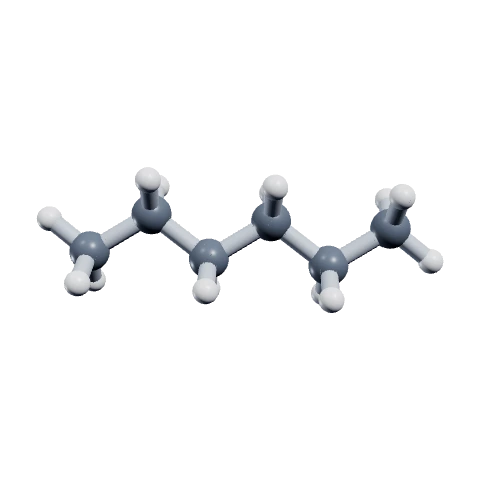


Most people have never bought a bottle of hexane, and almost all of them have eaten food made with it. Hexane is the solvent that washes the oil out of soybeans, canola and corn germ in large crushing plants, and it has done that job in the United States since the 1930s. It is also the solvent in rubber cement, a workhorse of the chromatography lab, and the reason a generation of shoe workers in Japan and Italy lost feeling in their feet.
That mix of ordinary and alarming is why the questions people ask about hexane are so different: what is it, is it in my cooking oil, is it bad for you, is it polar. This guide answers each one from the primary sources: the federal toxicology profile, the Code of Federal Regulations, EPA’s description of how oilseed plants work, and the European Union’s solvent rules. Where sources disagree, we say so. Every quotation is verbatim and linked at the end.
We sell Hexane Technical Grade and Hexane ACS Reagent Grade, from a one-quart can to a 55-gallon drum. The grade section near the end explains the difference.
Last reviewed 13 October 2026 against the sources cited below. This is a chemistry reference, not medical, legal or regulatory advice. How we researched it is set out at the end.
| Hexane at a glance | |
|---|---|
| Formula | C6H14 (CH3CH2CH2CH2CH2CH3 for n-hexane) |
| CAS number | 110-54-3 |
| Molar mass | 86.18 g/mol |
| Polarity | Nonpolar (dielectric constant 1.890 at 20 °C) |
| Main use | Extracting edible oil from soybeans and other oilseeds |
| Main hazard | Highly flammable; chronic n-hexane exposure can cause peripheral neuropathy |
| Shipping | UN1208, Hexanes, Class 3, Packing Group II |
What is hexane?
Hexane is a straight-chain alkane with six carbon atoms and fourteen hydrogens, C6H14, refined from crude oil and used as a volatile, nonpolar solvent. In the words of the federal Agency for Toxic Substances and Disease Registry (ATSDR), “n-Hexane is refined from crude oil and is primarily used as a volatile, non-polar solvent in industry.” It is a clear liquid that NIOSH describes as having “a gasoline-like odor.”
The word “hexane” is used for two related things, and the difference matters for both safety and specifications.
- n-Hexane is the single straight-chain molecule, CAS 110-54-3. ATSDR notes that “Laboratory-grade n-hexane contains approximately 99% n-hexane.”
- Hexane or hexanes in commerce is a blend. ATSDR: “‘Hexane’ or ‘hexanes’ is a commercial and industrial product consisting of a mixture of hydrocarbons with six carbon atoms and includes n-hexane and its isomers, 2-methylpentane and 3-methylpentane, as well as small amounts of other hydrocarbons.”
How much n-hexane the commercial blend contains depends on who you ask and which product. ATSDR gives a range of 20–80% for general commercial mixtures and 95–99% for products “intended for specialized oil extraction or laboratory uses.” EPA’s air rule for oilseed plants assumes extraction solvent has “an approximate HAP content of 64 percent by volume,” the HAP being n-hexane. A 2022 peer-reviewed review puts it at 50–85%. The honest summary: extraction hexane is mostly n-hexane, with the balance made up of its branched cousins.
The five hexane isomers
Five different molecules share the formula C6H14. They have the same atoms arranged in different skeletons, which shifts their boiling points by a few degrees and, as the health section explains, matters for toxicity.
| Isomer | CAS | Shape |
|---|---|---|
| n-Hexane | 110-54-3 | Straight chain of six carbons |
| 2-Methylpentane (isohexane) | 107-83-5 | Five-carbon chain, branch on carbon 2 |
| 3-Methylpentane | 96-14-0 | Five-carbon chain, branch on carbon 3 |
| 2,2-Dimethylbutane (neohexane) | 75-83-2 | Four-carbon chain, two branches on carbon 2 |
| 2,3-Dimethylbutane | 79-29-8 | Four-carbon chain, one branch on each of carbons 2 and 3 |
The European Union’s extraction-solvent law defines the commercial product by its distillation range rather than its purity: “Hexane means a commercial product consisting essentially of acyclic saturated hydrocarbons containing six carbon atoms and distilling between 64 °C and 70 °C.”
What is hexane used for?
Hexane’s main use is extracting edible oil from oilseeds; ATSDR states plainly that “Its primary use is as an edible oil extractant for seed crops.” The crops listed are soybeans, cottonseed, rapeseed (canola), flax, mustard seed, peanuts, safflower seed and corn germ. Beyond that, the same profile lists a long tail of industrial and laboratory work:
| Use | What hexane does there |
|---|---|
| Oilseed crushing | Dissolves the oil out of flaked seeds, then is boiled off and reused |
| Plant protein and flours | “Used in the defatting and extraction of plant protein” |
| Spice oleoresins and hop extracts | Pulls flavor compounds from spices and hops, under FDA residue limits |
| Adhesives | The solvent in rubber cement, “widely used in schools and libraries and by artists” |
| Degreasing and printing | Cleaner in textile, shoe, leather and furniture work, and a component of some inks |
| Tires and polymers | Thins rubber compounds; a solvent for olefin polymerization |
| Laboratory | Extraction solvent, chromatography mobile phase, instrument calibration, and the standard solvent in EPA’s oil-and-grease test |
Plant-material extraction outside the food industry, from essential oils to botanical concentrates, uses the same chemistry on a smaller scale. We cover that separately in our guide to hexane for botanical oil extraction.
How is hexane used to make cooking oil?
In a solvent-extraction plant, soybeans are cracked, dehulled and rolled into thin flakes, hexane washes the oil out of the flakes, and the hexane is then evaporated off both the oil and the meal, condensed and reused. The oilseed processors’ trade association, NOPA, describes the choice of solvent this way: “Since the 1930s, hexane has been the most widely used solvent to separate the fat (oil) from the protein (meal) in oilseeds due to its many beneficial attributes.”

EPA’s emissions handbook (AP-42) walks through the process step by step:
- Preparation. Bean preparation “consists of four principal operations: cracking, dehulling/hull removal, conditioning, and flaking.” The flakes are thin, about 0.25 to 0.51 mm, because “Flaking allows the soybean oil cells to be exposed and the oil to be more easily extracted.”
- Extraction. “The extraction process consists of ‘washing’ the oil from the soybean flakes with hexane solvent in a countercurrent extractor.” Fresh hexane meets the most-extracted flakes, so the solvent picks up oil all the way through.
- Desolventizing the meal. “The flakes leaving the extractor contain up to 35 to 40 percent solvent,” which is driven off with steam in a desolventizer-toaster.
- Recovering the solvent. The oil-and-hexane mixture, called miscella, is distilled; the hexane “is condensed, separated from the steam condensate, and reused.”
- Refining. Crude oil still carries “Small quantities of solvent (up to 0.2 percent by volume of oil)”. Later, “Volatile components are removed by deodorization, which uses steam injection under a high vacuum and temperature.”
Because hexane is a federally listed hazardous air pollutant, every US plant runs under an emissions permit. EPA’s vegetable-oil rule (40 CFR Part 63, Subpart GGGG) caps solvent loss for a conventional soybean plant at 0.2 gallons per ton of beans. In the 1990s data EPA summarized, plants reported an average loss of 0.89 gallons per ton, so the rule represents a large tightening.
The alternative most shoppers have heard of is mechanical pressing, sold as “expeller pressed” or “cold pressed” oil. We found no FDA or USDA definition of either term; they describe oil pressed out mechanically rather than extracted with a solvent.
Is there hexane in cooking oil?
Refined vegetable oils can contain trace residues of hexane, typically measured in low parts per million, because deodorization strips out nearly all of what survives the plant’s solvent recovery. ATSDR’s 2025 toxicological profile summarizes the measurements:
“In studies of fully processed edible oil products carried out in the 1960s, it was determined that n-hexane residues were generally at levels <10 ppm. Investigations using more precise modern analysis techniques concluded that residual n-hexane residues for refined food products would be <2 ppm.”
ATSDR then does the arithmetic. Assuming 80 g of fat a day for a 70 kg adult, those levels “would be the equivalent of no more than 2.29 μg/kg/day of n-hexane, which is a toxicologically insignificant amount.” That is the federal toxicology agency’s own phrase.
Residues are not always that low. A 2022 review in the journal Foods reports a Spanish survey that found hexane in two oils at 2 and 3 mg/kg, and a set of Iranian oils with residues up to 11.10 mg/kg, above the European limit.
What the rules say in the US, the EU and organic
| Rule | What it sets for hexane |
|---|---|
| FDA, 21 CFR 173.270 | Spice oleoresins: not more than 25 ppm. Hops extract: not more than 2.2% by weight, added to wort before or during cooking |
| FDA, 21 CFR 172.340 | Fish protein isolate: not more than 5 ppm hexane |
| FDA, 21 CFR 184.1259 | Cocoa butter substitute: not more than 5 ppm |
| FDA, 21 CFR 172.894 | Modified cottonseed products: no more than 60 ppm n-hexane |
| FDA, vegetable oil | We found no section of 21 CFR Parts 172, 173 or 184 that sets a hexane limit for vegetable oil itself |
| EU, Directive 2009/32/EC | Fats, oils and cocoa butter: 1 mg/kg. Defatted protein products and flours: 10 mg/kg in the food (30 mg/kg in defatted soya products sold to consumers). Defatted cereal germs: 5 mg/kg |
| USDA organic, 7 CFR 205.270(c)(2) | Organic handlers may not use “A volatile synthetic solvent or other synthetic processing aid not allowed under § 205.605” |
Two points are worth spelling out. First, you will not see hexane on an ingredient list. FDA’s labeling rule exempts “Substances that are added to a food during the processing of such food but are removed in some manner from the food before it is packaged in its finished form.” The rule does not name hexane; reviewers such as the 2022 Foods paper treat hexane as a processing aid under it. Second, the organic rule does not name hexane either, but hexane is a volatile synthetic solvent, and the standard reading is that it cannot be used to extract an ingredient sold as organic.
Is anything changing? In Europe, yes. EFSA, the EU food-safety agency, states that it “is currently re-evaluating the safety of hexane as an extraction solvent.” Its 2024 technical report concluded that the data behind the 1996 evaluation were no longer sufficient, the European Commission issued the mandate on 23 May 2025, and EFSA’s call for data closed in October 2025. No new opinion had been published when we last checked. In the US, we found no current FDA proceeding on hexane; the active petition on extraction solvents covers four other chemicals.
The takeaway: hexane has been the standard solvent for extracting oilseeds since the 1930s, and trace amounts can remain, but measured residues in refined oil are usually a few parts per million or less. Regulators on both sides of the Atlantic treat the solvent as acceptable at those levels, and Europe is reviewing that position now.
Is hexane bad for you?
Hexane is hazardous mainly to people who breathe its vapor at work for long periods: chronic inhalation of n-hexane can cause peripheral neuropathy, a loss of feeling and strength that starts in the hands and feet. The mechanism is a metabolite. ATSDR: “The neurotoxicity of n-hexane is believed to ultimately result from the effects the n-hexane metabolite, 2,5-hexanedione, on peripheral nerves.”
The history is grim and well documented:
- Japan and Italy, 1960s–70s. ATSDR: “Human toxicity associated with n-hexane was first recognized in the 1960s and early 1970s in Japan and Italy. Workers in the shoe industries in these countries developed peripheral neuropathy that started with numbness in the feet and hands (sometimes referred to as glove and stocking neuropathy), followed by weakness in the lower legs and feet.” One of the first large investigations was a case series of 93 sandal makers exposed through glues and solvents.
- China, 2010. Apple’s 2011 supplier report disclosed that “137 workers at the Suzhou facility of Wintek, one of Apple’s suppliers, had suffered adverse health effects following exposure to n-hexane, a chemical in cleaning agents used in some manufacturing processes.” The cause: “the factory had reconfigured operations without also changing their ventilation system.”
The common factor is ventilation. ATSDR notes that “In all cases, poor ventilation was a major factor in the illness,” and that “Removal from the workplace resulted in recovery for most patients over the course of several months to 2 years.” It also explains why US cases are comparatively rare: “in the United States, n-hexane is used mainly in closed systems (e.g., for extraction of vegetable oils).”
| Exposure limit | Value |
|---|---|
| OSHA PEL (legal limit, 8-hour TWA) | 500 ppm (1,800 mg/m³) |
| NIOSH REL (recommended, up to 10-hour TWA) | 50 ppm (180 mg/m³) |
| Cal/OSHA PEL | 50 ppm |
| IDLH (immediately dangerous to life or health) | 1,100 ppm, set at 10% of the lower explosive limit |
The 10× gap. The federal OSHA limit for n-hexane is ten times higher than what NIOSH recommends and what California enforces. If you are writing a procedure, design to 50 ppm, not 500.
Other short-term effects listed by NIOSH include eye and nose irritation, headache, dizziness and skin irritation, and swallowed hexane can be aspirated into the lungs. On cancer, EPA’s IRIS assessment found “Inadequate information to assess carcinogenic potential,” and IARC has not evaluated it.
The branched isomers are less clear-cut. The nerve damage is tied to the 2,5-hexanedione that n-hexane forms. In a 1988 rulemaking, NIOSH argued that all C5–C8 alkanes should be treated as potential nerve toxins; OSHA disagreed, and the separate isomer limits it set were later struck down in court. This is one reason the n-hexane content of a commercial hexane matters to industrial hygienists.
Is hexane polar?
No, hexane is nonpolar. It is a pure hydrocarbon with no oxygen, nitrogen or charged groups, and its dielectric constant is 1.890 at 20 °C (National Bureau of Standards Circular 514), one of the lowest of any common solvent. Water’s is around 80.
That is the whole reason it works on oil. Fats and oils are nonpolar too, and like dissolves like, so hexane takes up oil readily while barely mixing with water: ATSDR lists its water solubility at about 9.5 mg/L.

In the laboratory, that low polarity makes hexane a standard mobile phase for normal-phase chromatography. A NIST-led study puts it simply: “when a nonpolar mobile phase such as n-hexane is used, a hydrocarbon class separation similar to that obtained on silica and alumina is achieved.” Environmental labs use it too: EPA Method 1664 measures “n-hexane extractable material (HEM; oil and grease)” in water and wastewater, and the method specifies hexane of at least 85% n-hexane purity.
What are hexane’s physical properties?
n-Hexane boils at about 69 °C (156 °F), freezes at about −95 °C (−139 °F) and has a density of about 0.66 g/cm³, so it floats on water. The values below are from NIST, ATSDR, NIOSH and PubChem; our hexane property page carries the full data sheet.
| Property | Value | Source |
|---|---|---|
| Boiling point | 68.7 °C (156 °F) | PubChem (CRC), NIST, NIOSH |
| Melting point | −95 °C (−139 °F) | NIST, ATSDR |
| Density | 0.6606 g/cm³ at 20 °C | ATSDR |
| Flash point (closed cup) | −22 °C (−7 °F) | PubChem (NFPA), NIOSH |
| Autoignition temperature | 225 °C (437 °F) | PubChem (NFPA), ATSDR |
| Flammable limits in air | 1.1% to 7.5% | NIOSH, ATSDR |
| Vapor pressure | About 120 mmHg at 20 °C | PubChem (Verschueren) |
| Vapor density | 2.97 (air = 1) | PubChem |
| Water solubility | 9.5 mg/L at 25 °C | PubChem, ATSDR |
| log Kow | 3.90 | PubChem, ATSDR |
One correction for anyone checking sources: the NIOSH Pocket Guide lists the freezing point as −219 °F. NIST, the CRC Handbook, ATSDR and the National Toxicology Program all give about −95 °C, which is −139 °F. The NIOSH figure appears to treat −139 as Celsius.
Two of those numbers matter most for fire safety. A vapor density near 3 means the vapor is heavier than air and pools along floors and into drains, and a flash point of −22 °C means there is enough vapor to ignite at any temperature you are likely to work in.
Hexane vs heptane: what is the difference?
Heptane (C7H16) is hexane’s seven-carbon neighbor: similarly nonpolar, but slower to evaporate, with a boiling point near 98 °C. Hexane’s nerve toxicity is specific to its 2,5-hexanedione metabolite, so whether heptane suits a process is a question for your own safety review and specification, not a blanket swap. We compare the two in detail in n-heptane vs hexane and in our complete n-heptane guide. Petroleum ether, a lighter blend that often contains hexane, is covered in hexane vs petroleum ether.
Which hexane grade do you need?
Choose Hexane ACS Reagent Grade for analytical work, where a published specification and a certificate of analysis matter, and Hexane Technical Grade for extraction, cleaning and process use, where cost per gallon matters more. Both are CAS 110-54-3 and both ship in the same pack sizes.
| Pack | Hexane Technical Grade | Hexane ACS Reagent Grade |
|---|---|---|
| 1 quart can | $25.35 | $30.42 |
| 1 gallon can | $47.67 | $57.89 |
| 5 gallon pail | $143.91 | $175.89 |
| 55 gallon drum | $1,176.67 | $1,434.96 |
Prices read from our product pages on 13 October 2026; check the product page for current pricing and case packs.
- Hexane ACS Reagent Grade is listed for HPLC mobile phase, extraction, precision cleaning, reaction medium and instrument calibration. A lot certificate of analysis is available on request.
- Hexane Technical Grade is listed for extraction, degreasing and parts cleaning, chromatography, and use as a reaction medium or general laboratory solvent.
Volume changes the math more than grade does. A single gallon of Technical Grade works out to $47.67 a gallon; the 55-gallon drum works out to about $21.39 a gallon. If you use more than a few pails a year, ask for drum or pallet pricing.
How is hexane shipped and stored?
Hexane ships as a flammable liquid under the proper shipping name “Hexanes,” UN1208, Hazard Class 3, Packing Group II, and should be stored tightly closed, grounded and away from every ignition source. Under the federal Hazardous Materials Table, passenger aircraft may carry no more than 5 L per package and cargo aircraft 60 L; the emergency response guide is number 128.
- Store in a cool, ventilated flammables area, away from strong oxidizers, which NIOSH lists as incompatible.
- Bond and ground drums and containers during transfer; a moving nonpolar liquid builds static charge.
- Work with local exhaust ventilation and keep exposure below 50 ppm. Remember that the vapor is heavier than air.
- Read the safety data sheet before first use. The Hexane Technical Grade SDS and Hexane ACS Reagent Grade SDS are on our documents portal.
Hexane’s place among the other hydrocarbon solvents, from mineral spirits to toluene and xylene, is mapped in our buyer’s guide to petroleum-derived solvents.
How we researched this
We built this guide from primary sources: ATSDR’s Toxicological Profile for n-Hexane (April 2025), the NIOSH Pocket Guide, OSHA’s annotated limits table, the current Code of Federal Regulations (Titles 7, 21, 40 and 49, read through eCFR in October 2026), EPA’s AP-42 chapter on vegetable oil processing and Method 1664, the EU extraction-solvent directive, EFSA’s published statements on its hexane re-evaluation, NIST and PubChem property data, NOPA’s hexane fact sheet, peer-reviewed papers and Apple’s 2011 supplier report. Where sources disagree, as they do on the n-hexane content of commercial hexane and on one freezing-point value, we say so. Prices were read from our product pages on 13 October 2026. The images are illustrations, not test results. We did not run our own experiments for this article.
Key numbers and sources
All web sources were read on 13 October 2026. Quotations are verbatim.
- Toxicological Profile for n-Hexane, Agency for Toxic Substances and Disease Registry (April 2025)
- NIOSH Pocket Guide to Chemical Hazards: n-Hexane, CDC / NIOSH
- Permissible Exposure Limits, Annotated Table Z-1, OSHA
- 1988 OSHA PEL Project: Hexane Isomers, CDC / NIOSH
- n-Hexane, NIST Chemistry WebBook, National Institute of Standards and Technology
- Hexane (CID 8058), PubChem, National Library of Medicine
- Table of Dielectric Constants of Pure Liquids (Circular 514), Maryott and Smith, National Bureau of Standards (1951)
- The Use of Hexane in Oilseed Processing, National Oilseed Processors Association (2023)
- AP-42 Section 9.11.1, Vegetable Oil Processing, US Environmental Protection Agency (1995)
- 40 CFR Part 63 Subpart GGGG, NESHAP: Solvent Extraction for Vegetable Oil Production, eCFR
- 42 U.S.C. 7412, Hazardous air pollutants, GovInfo
- 21 CFR 173.270, Hexane, eCFR
- 21 CFR 172.340, Fish protein isolate, eCFR
- 21 CFR 184.1259, Cocoa butter substitute, eCFR
- 21 CFR 172.894, Modified cottonseed products intended for human consumption, eCFR
- 21 CFR 101.100, Food; exemptions from labeling, eCFR
- 7 CFR 205.270, Organic handling requirements, eCFR
- Directive 2009/32/EC on extraction solvents, Annex I, legislation.gov.uk copy of the EU text
- Extraction solvents, European Food Safety Authority
- Call for data on hexane as an extraction solvent (EFSA-Q-2025-00358), European Food Safety Authority (2025)
- Towards Substitution of Hexane as Extraction Solvent of Food Products and Ingredients with No Regrets, Cravotto et al., Foods 11 (2022)
- Shape selectivity and normal-phase separations of polycyclic aromatic hydrocarbons, Wilson, Hayes, Sander, Campiglia and Wise, Analytical and Bioanalytical Chemistry 409 (2017)
- Method 1664, Revision B: n-Hexane Extractable Material, US Environmental Protection Agency (2010)
- 49 CFR 172.101, Hazardous Materials Table, eCFR
- Supplier Responsibility 2011 Progress Report, Apple (archived copy)
Frequently asked questions
What is hexane in simple terms?
Hexane is a clear, fast-evaporating liquid made from crude oil. It is a hydrocarbon with six carbon atoms (C6H14) that dissolves oils and greases, which is why it is used to extract cooking oil from soybeans and in glues, degreasers and laboratories.
Is hexane the same as n-hexane?
Not always. n-Hexane is the single straight-chain molecule. Commercial hexane or hexanes is a mixture of n-hexane and its branched isomers such as 2-methylpentane and 3-methylpentane. Laboratory grades are close to pure n-hexane, while industrial blends vary.
Is there hexane in vegetable oil?
Refined vegetable oil can contain trace residues. ATSDR cites modern analysis showing residual n-hexane in refined food products below 2 ppm, which it calls toxicologically insignificant. The EU sets a legal limit of 1 mg/kg in fats and oils.
Why is hexane not listed on food labels?
FDA rules exempt from ingredient labeling substances that are added during processing and removed before the food is packaged. Hexane is generally treated as such a processing aid because it is evaporated off the oil.
Is hexane carcinogenic?
EPA's IRIS assessment found inadequate information to assess its carcinogenic potential, and IARC has not evaluated hexane. Its documented chronic hazard is nerve damage from long-term inhalation of n-hexane.
What does hexane do to the body?
Breathing high levels of n-hexane over months can damage peripheral nerves, starting with numbness in the hands and feet and progressing to weakness. The body converts n-hexane to 2,5-hexanedione, which damages nerves. Short-term exposure can cause dizziness, headache and eye or nose irritation.
What is the boiling point of hexane?
n-Hexane boils at about 69 degrees Celsius, or 156 degrees Fahrenheit. Commercial hexane blends distill over a range; the EU defines extraction hexane as distilling between 64 and 70 degrees Celsius.
Does hexane dissolve in water?
Barely. Hexane is nonpolar, and its solubility in water is about 9.5 mg/L at 25 degrees Celsius. It floats on water, with a density of about 0.66 g/cm3.
Is hexane allowed in organic food?
USDA organic rules bar handlers from using volatile synthetic solvents not on the National List in organic products. Hexane is a volatile synthetic solvent, so the standard reading is that it cannot be used to extract ingredients sold as organic.
How is hexane shipped?
As a Class 3 flammable liquid: proper shipping name Hexanes, UN1208, Packing Group II. Passenger aircraft are limited to 5 liters per package and cargo aircraft to 60 liters.
Related Chemical Collections
About the author
Andre Taki
This article is for informational purposes only.


