

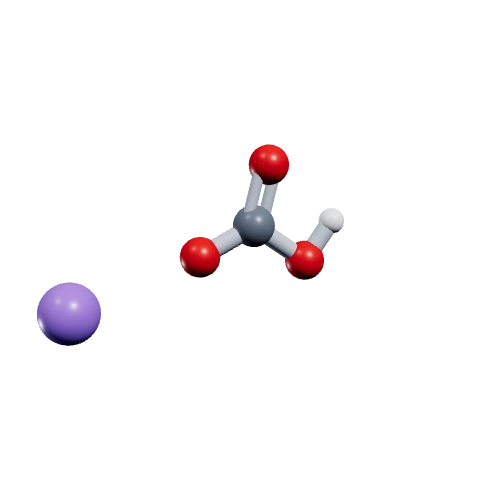


Spraying baking soda on powdery mildew is one of the most repeated tips in gardening. It also has a flaw that compounds the longer you do it — and there is a reason the three bicarbonate fungicides that actually cleared EPA registration are not built on baking soda at all. They are built on its potassium cousin. Here is the chemistry, what the peer-reviewed work actually found, what the registered labels actually say, and where the line sits between a chemical and a pesticide.
Key facts at a glance
| Property | Value | Source |
|---|---|---|
| Chemical name | Potassium bicarbonate (potassium hydrogen carbonate) | PubChem CID 516893 |
| Formula / CAS | KHCO₃ · CAS 298-14-6 | PubChem |
| Molecular weight | 100.115 g/mol | PubChem |
| Appearance | White, odourless crystalline powder; highly soluble in water | FCC / USP monograph |
| Thermal behaviour | Decomposes at roughly 100–120 °C (2 KHCO₃ → K₂CO₃ + CO₂ + H₂O). It has no true melting point — it breaks down before it melts. | CRC / thermal-decomposition literature |
| Hygroscopic? | Yes — cakes if stored open in humid air | Supplier handling data |
| EPA pesticide status | Biochemical pesticide; exempt from tolerance requirement | 40 CFR § 180.1177 |
| Registered fungicides | MilStop SP (70870-1) · Kaligreen (11581-2) · Armicarb "O" (5905-541) | EPA pesticide product labels |
What is potassium bicarbonate, and how is it different from baking soda?
Potassium bicarbonate is the potassium salt of bicarbonate — KHCO₃, a white, odourless, crystalline powder with very high water solubility. It is a close cousin of sodium bicarbonate (NaHCO₃, common baking soda): both are Group 1 metal bicarbonates, both dissolve readily, and both raise the pH of the surface they land on. The difference that matters is which metal ion rides along with the bicarbonate — sodium (Na⁺) or potassium (K⁺).
That one-atom swap changes the agronomy completely. Sodium is not a plant nutrient in any meaningful sense; at the concentrations that build up from repeated sprays it is actively harmful, competing with potassium and calcium for the same root uptake channels and accumulating in leaf tissue and topsoil. Potassium is one of the three primary macronutrients plants need — the "K" in N-P-K. Both sprays leave a residue once the water evaporates. Only one of those residues is plant food.
How does potassium bicarbonate actually control powdery mildew?

Powdery mildew is unusual among plant fungal diseases: the white, dusty coating is a mat of mycelium and spores sitting on the leaf surface rather than growing inside the tissue. That is the only reason a surface-contact treatment can reach it at all.
The mechanism is physical, not metabolic. When Ziv and Zitter examined bicarbonate-treated cucurbit foliage, what they documented was collapse of the hyphal walls and shrinkage of the conidia, leaving the fungus unable to sporulate — the same structural damage Punja and Grogan had reported a decade earlier. The dissolved salt draws water out of fungal cells osmotically, and the bicarbonate ion disrupts the ion balance the cell needs to hold its shape. Raising leaf-surface pH contributes, but the ionic and osmotic collapse is the part the microscopy actually shows.
The second thing the literature makes clear, and which the popular version of this tip almost always omits: in the rose trials by Horst, Kawamoto and Porter, bicarbonate's effectiveness depended heavily on being combined with a horticultural spray oil at about 1% v/v. Bicarbonate alone performed substantially worse. The oil helps the spray wet and adhere to a waxy, hydrophobic mildew colony. Every commercial bicarbonate fungicide sold today is a formulated product with wetting and dispersing agents for exactly this reason — which is a large part of why a formulated product outperforms a bucket of dissolved salt.
Because the mode of action is multi-site and physical rather than a single-site metabolic poison, it is not the kind of chemistry that fungal populations adapt to quickly — a genuine advantage in a rotation, though not a licence to use it as the only tool.
What application rates do the registered labels specify?
This is the most-asked question about this chemistry, and it has a precise answer — but the answer belongs to the registered products, not to bulk chemical. The rates below are published on the EPA-approved labels and are reproduced here so growers can find them; the label that ships with the product is always the controlling document, and using any pesticide inconsistently with its labelling is a federal violation.
| Product | Active ingredient | Published label rate |
|---|---|---|
| MilStop SP EPA Reg. No. 70870-1 |
85% potassium bicarbonate | Preventive: 2.5 lb/acre every 14 days. Curative: up to 5 lb/acre weekly for three weeks. Sensitive crops: 2.5 lb per 100 gal water. |
| Kaligreen EPA Reg. No. 11581-2 |
82% potassium bicarbonate (microencapsulated) | Per label, by crop; consult current label. |
| Armicarb "O" EPA Reg. No. 5905-541 |
Potassium bicarbonate | Per label, by crop; consult current label. |
Why does the sodium bicarbonate hack backfire over time?
The backfire is cumulative, not immediate — which is exactly why the tip has survived so long online. A single baking-soda spray does knock back a young colony. The problem shows up after the fifth, tenth or twentieth application across a season.
Each spray leaves sodium on the leaf surface and, as runoff, in the topsoil. Sodium does not break down or get consumed the way a nutrient does; it accumulates. Over a season of weekly sprays on the same rose bed, squash patch or greenhouse bench, that load can produce leaf-margin scorch, depress potassium and calcium uptake because sodium competes for the same channels, and measurably raise salinity in containers or raised beds where there is little soil volume to buffer it.
None of this is a hypothetical worst case — it is the standard agronomic argument against long-term sodium bicarbonate use, and it is why formulators reached for the potassium salt when they built registered products. Treating one tomato plant twice, the difference is invisible. Managing a vineyard block on a season-long schedule, it is the whole story.
Is potassium bicarbonate good for plants beyond disease control?
Yes, and this is the part worth understanding separately from the fungicide question. Bicarbonate breaks down to carbon dioxide and water while the potassium ion remains, so what stays behind on the leaf is a small, fast-available dose of potassium — the nutrient governing stomatal water regulation, enzyme activation and the plant's own stress tolerance.
Two honest caveats. First, the quantity delivered by a foliar spray is modest; potassium bicarbonate is a supplement to a fertility programme, not a replacement for one. Second, potassium bicarbonate raises pH, so it is a poor choice where soil or media are already alkaline, and it should not be treated as interchangeable with an acidifying potassium source such as potassium sulfate. Growers on alkaline irrigation water in particular should watch cumulative bicarbonate loading, which is its own well-documented problem in horticulture.
Is potassium bicarbonate organic and OMRI-listed?
The finished commercial products — MilStop, Kaligreen and Armicarb — carry OMRI (Organic Materials Review Institute) listings, meaning they have been reviewed against USDA National Organic Program standards (7 CFR Part 205) for use on certified-organic crops.
That listing belongs to the specific formulation, concentration and label that went through review. It does not transfer to raw potassium bicarbonate in the abstract, and an OMRI listing is not a substitute for EPA registration — they are two separate reviews answering two different questions. Our FCC/USP grade potassium bicarbonate is high-purity food and pharmaceutical raw material. It is not a labelled pesticide and carries no OMRI listing of its own.
How does residue testing affect hemp and cannabis?
Powdery mildew is one of the heaviest disease pressures in cannabis and hemp cultivation — the dense canopy and high humidity that indoor and greenhouse grows favour for yield are exactly what the fungus prefers. That collides with state-mandated pesticide residue testing before flower can be sold, where many conventional synthetic fungicides are disqualifying even at trace levels.
MilStop SP is labelled for use on hemp in greenhouse and field, which is a concrete, verifiable fact rather than a general impression. Marijuana is a different matter: because it remains federally controlled, EPA does not register pesticides for it, so every allowance runs through a state cannabis or agriculture department list. Those lists vary by state, change, and are the only authority that matters for a given grow.
Potassium bicarbonate vs. sodium bicarbonate vs. copper fungicides
Growers choosing among "natural" fungicide chemistries are usually comparing these three. Here is how they differ where it counts.
| Chemistry | Mechanism | Long-term drawback | Regulatory status |
|---|---|---|---|
| Sodium bicarbonate (baking soda) | Osmotic/ionic collapse of hyphae + pH shift | Sodium accumulates in soil and leaf tissue with repeat use | No EPA-registered fungicide product |
| Potassium bicarbonate | Same physical mechanism; residue is a plant nutrient | Fungistatic and contact-only — needs repeat application per label | EPA-registered (70870-1, 11581-2, 5905-541); products OMRI-listed |
| Copper fungicides | Multi-site metal-ion toxicity | Copper does not break down; accumulates in soil indefinitely; phytotoxicity risk | EPA-registered; OMRI-listed, with documented soil-accumulation concerns |
The copper comparison is the one that matters over multiple seasons. Copper is the other major organic-approved fungicide family, and it carries a cost that bicarbonate does not: it accumulates in soil indefinitely, eventually reaching concentrations that suppress soil microbial activity and, high enough, injure the crop. Bicarbonate's byproduct is a plant nutrient rather than an accumulating heavy metal — a meaningful difference for a perennial planting like a vineyard or orchard.
In practice most IPM programmes rotate rather than pick one, both to slow adaptation and to spread accumulation risk. Bicarbonate's usual role in that rotation is the fast-knockdown, low-residue option used between copper applications, or ahead of a harvest window where copper's persistence would be unwelcome.
Potassium bicarbonate vs. potassium carbonate — not the same thing
These get conflated constantly, and the difference is practical. Potassium carbonate (K₂CO₃, CAS 584-08-7) is the fully deprotonated salt: a much stronger base, with a solution pH around 11–12 against roughly 8.2–8.6 for bicarbonate at typical concentrations. That extra alkalinity substantially raises the risk of leaf burn, which is why the registered foliar fungicides are built on the bicarbonate and not the carbonate.
Potassium carbonate does have its own EPA-registered fungicide uses, but the two are not interchangeable in a tank, and a recipe written for one should never be run with the other. The same warning applies to potassium hydroxide, which is a corrosive base and an entirely different safety proposition.
What grade do formulators and manufacturers need?

The commercial fungicides above are formulated goods: a registered active ingredient blended with approved inert ingredients under an EPA-reviewed label. The raw material feeding that kind of formulation — or a lab's own R&D — needs to be well characterised and consistent lot to lot. That is what FCC (Food Chemicals Codex) and USP (United States Pharmacopeia) grade signal: documented purity and impurity-profile standards originally written for food and pharmaceutical use.
Alliance Chemical stocks Potassium Bicarbonate — FCC/USP Grade as a fine white crystalline powder with uniform granulation and high water solubility, shipped from our facility in Taylor, Texas:
| Pack size | Typical buyer |
|---|---|
| 2 lb – 8 lb (multi-packs) | Bench-scale work, small trial batches |
| 5 lb – 20 lb (multi-packs) | Food and beverage production, laboratory use, pilot batches |
| 50 lb bags, single | Production users, co-ops, small formulators |
| 500 – 2,000 lb (bulk bag quantities) | Formulators and manufacturers scaling a production programme |
Ask for the certificate of analysis and we will send it at no charge — the detail that matters most once you are running a documented process, whether that documentation is for a certifier, a regulator or your own quality system.
Handling and storage: what actually goes wrong
The failure modes we see most often from customers handling this material are unglamorous and easy to prevent.
- Caking from moisture. Potassium bicarbonate is hygroscopic. Left in a poorly sealed bag in a humid room it will clump — a handling and dosing problem rather than a chemistry problem, but it will ruin an automated feed. Reseal bags tightly and store dry.
- Heat exposure in storage. Because it decomposes rather than melts, sustained warmth degrades material to potassium carbonate over time, shifting both assay and solution pH. Keep it away from heat sources; do not store it against a greenhouse wall in summer.
- Assuming bicarbonates are interchangeable. Ammonium bicarbonate, sodium carbonate ("washing soda") and potassium carbonate are all suggested as substitutes in DIY guides. None has the same profile: sodium carbonate carries the sodium problem and a higher pH, and ammonium bicarbonate is a different beast again.
- Incompatible combinations. Bicarbonate salts react with acids and behave unpredictably with some oils and alkaline partners. Anyone combining actives should verify compatibility on a small scale first.
And whatever finished product is ultimately applied, the same three label checks apply every time: confirm the active ingredient percentage, confirm the crop being treated is listed, and confirm the pre-harvest interval. Those checks take under a minute and catch most application mistakes before they happen.
Sources
- Ziv, O. & Zitter, T.A. (1992). Effects of bicarbonates and film-forming polymers on cucurbit foliar diseases. Plant Disease 76:513–517. — hyphal collapse and conidial shrinkage; fungistatic action.
- Horst, R.K., Kawamoto, S.O. & Porter, L.L. (1992). Effect of sodium bicarbonate and oils on the control of powdery mildew and black spot of roses. Plant Disease 76:247–251. — the horticultural-oil dependency.
- Punja, Z.K. & Grogan, R.G. (1982). — earlier report of bicarbonate-induced structural damage to fungal cells.
- 40 CFR § 180.1177 — Potassium bicarbonate; exemption from the requirement of a tolerance (eCFR).
- MilStop SP label (PDF), BioWorks Inc. — EPA Reg. No. 70870-1, 85% potassium bicarbonate, hemp use, application rates.
- Kaligreen label (PDF), US EPA pesticide product label system — EPA Reg. No. 11581-2.
- PubChem CID 516893 — identity, formula and molecular weight.
- USDA AMS National Organic Program — 7 CFR Part 205. · OMRI — organic input review.
FCC/USP Grade potassium bicarbonate — COA on request, no charge
KHCO₃, CAS 298-14-6. From 2 lb packs to 2,000 lb bulk bags, shipped from Taylor, Texas. Tell us your application and target purity and we will help you spec the right grade and size — from a trial batch to a full production run.
Frequently asked questions
How much potassium bicarbonate do you use for powdery mildew?
The rate belongs to the registered product, not to bulk chemical. MilStop SP (EPA Reg. No. 70870-1, 85% potassium bicarbonate) publishes a preventive rate of 2.5 lb per acre every 14 days, a curative rate of up to 5 lb per acre weekly for three weeks, and 2.5 lb per 100 gallons of water on sensitive crops. Kaligreen (EPA Reg. No. 11581-2) and Armicarb "O" (EPA Reg. No. 5905-541) publish their own crop-specific rates. The label shipped with the product is always the controlling document, and applying any pesticide inconsistently with its labelling is a federal violation.
Does potassium bicarbonate kill powdery mildew?
It arrests it rather than eradicating it. Published microscopy shows bicarbonate collapsing the walls of fungal hyphae and shrinking conidia so the colony cannot sporulate, and the literature characterises the action as fungistatic rather than fungicidal (Ziv & Zitter, Plant Disease 76:513–517, 1992). There is no lasting residue, which is why every registered label specifies a repeat schedule instead of a single application. Claims that one spray cures mildew should be treated sceptically.
Is potassium bicarbonate the same as baking soda?
No. Baking soda is sodium bicarbonate (NaHCO₃). Potassium bicarbonate is KHCO₃ — the same bicarbonate ion paired with potassium instead of sodium. Both disrupt fungal cells by the same physical mechanism, but sodium is not a plant nutrient and accumulates in leaf tissue and soil with repeated sprays, while potassium is a primary macronutrient. No sodium bicarbonate product is EPA-registered as a fungicide; three potassium bicarbonate products are.
Is potassium bicarbonate organic and OMRI-listed?
The finished commercial products — MilStop, Kaligreen and Armicarb — carry OMRI listings, meaning they were reviewed against USDA National Organic Program standards (7 CFR Part 205) for use on certified-organic crops. That listing belongs to the specific reviewed formulation and label. It does not transfer to raw potassium bicarbonate, and an OMRI listing is not a substitute for EPA registration — they are two separate reviews.
Is potassium bicarbonate good for plants?
Bicarbonate breaks down to carbon dioxide and water while the potassium ion remains, so a foliar application leaves a small, fast-available dose of potassium — the nutrient governing stomatal water regulation and enzyme activation. Two caveats: the quantity is modest, so it supplements rather than replaces a fertility programme; and it raises pH, so it is a poor fit where soil, media or irrigation water are already alkaline.
Can potassium bicarbonate be used on cannabis or hemp?
MilStop SP is labelled for use on hemp in greenhouse and field. Marijuana is different: because it remains federally controlled, EPA does not register pesticides for it, so every allowance runs through a state cannabis or agriculture department list. Those lists vary by state and change. An OMRI listing does not automatically clear a product for cannabis anywhere, and a hemp label is not a marijuana label — verify your state programme and the specific product label each season.
What is the difference between potassium bicarbonate and potassium carbonate?
Potassium carbonate (K₂CO₃, CAS 584-08-7) is the fully deprotonated salt and a much stronger base — solution pH around 11–12 versus roughly 8.2–8.6 for the bicarbonate. That extra alkalinity substantially raises leaf-burn risk, which is why the registered foliar fungicides are built on the bicarbonate. The two are not interchangeable in a tank mix.
What is the chemical formula, CAS number and PubChem CID of potassium bicarbonate?
The formula is KHCO₃, the CAS number is 298-14-6, and the PubChem CID is 516893. Molecular weight is 100.115 g/mol. It is a white, odourless crystalline powder with high water solubility. It has no true melting point — it decomposes at roughly 100–120 °C to potassium carbonate, carbon dioxide and water.
Does potassium bicarbonate go bad in storage?
It does not spoil, but two things degrade it. It is hygroscopic, so an open or poorly sealed bag in humid air will cake — a dosing and handling problem rather than a chemistry one. And because it decomposes rather than melts, sustained warmth slowly converts it to potassium carbonate, shifting both assay and solution pH. Reseal tightly, store dry and keep it away from heat sources.
What grade of potassium bicarbonate do formulators need?
FCC (Food Chemicals Codex) and USP (United States Pharmacopeia) grade signal documented purity and a consistent impurity profile — standards written for food and pharmaceutical use, which is the lot-to-lot consistency a formulator needs. Alliance Chemical supplies FCC/USP grade potassium bicarbonate from 2 lb packs to 2,000 lb bulk bags with the certificate of analysis on request at no charge, shipped from Taylor, Texas.
Does Alliance Chemical sell potassium bicarbonate as a fungicide?
No. We supply potassium bicarbonate as FCC/USP grade raw material for food, pharmaceutical and formulation use. It is not an EPA-registered pesticide and is not sold for pest control. If you need to spray for powdery mildew, buy a registered product such as MilStop, Kaligreen or Armicarb and follow its label. If you are formulating a product that will carry pesticidal claims, that route runs through EPA registration and your state lead agency before first sale — and the raw material is where it starts.
Related Chemical Collections
About the author
Andre Taki
This article is for informational purposes only.
