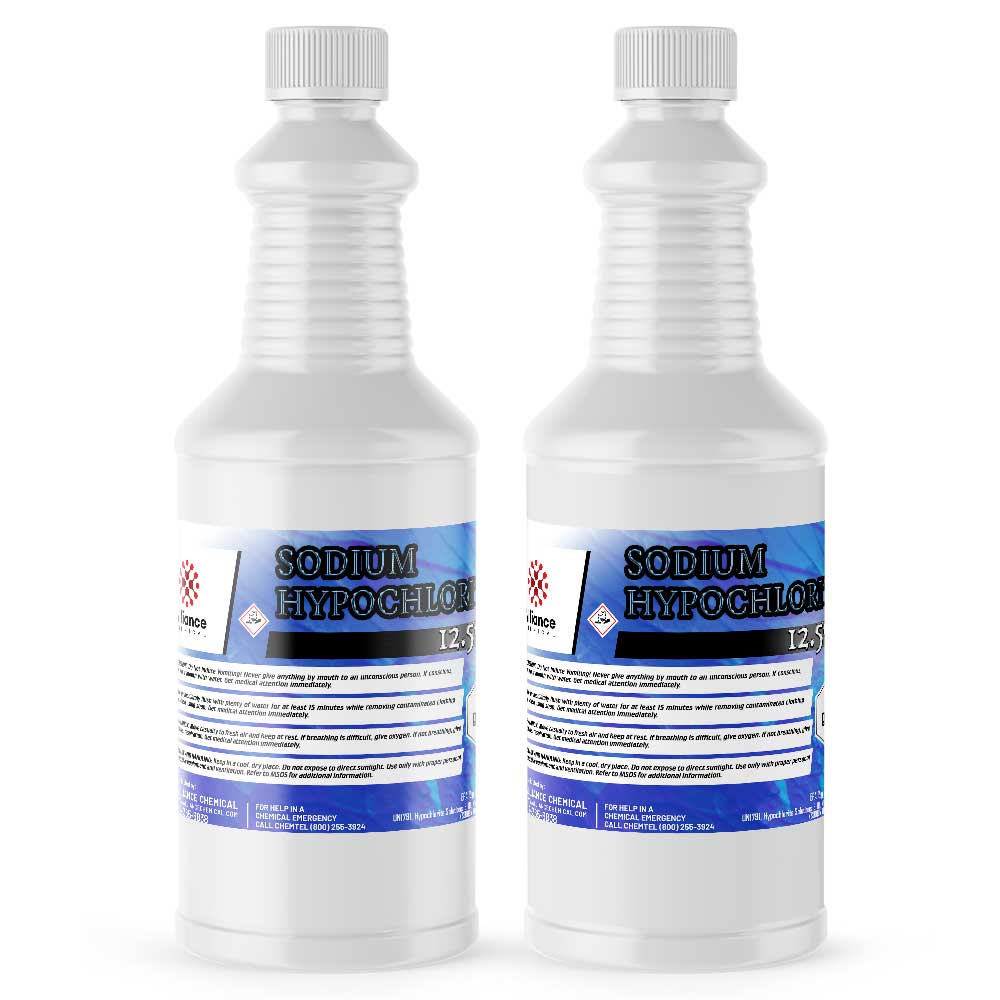
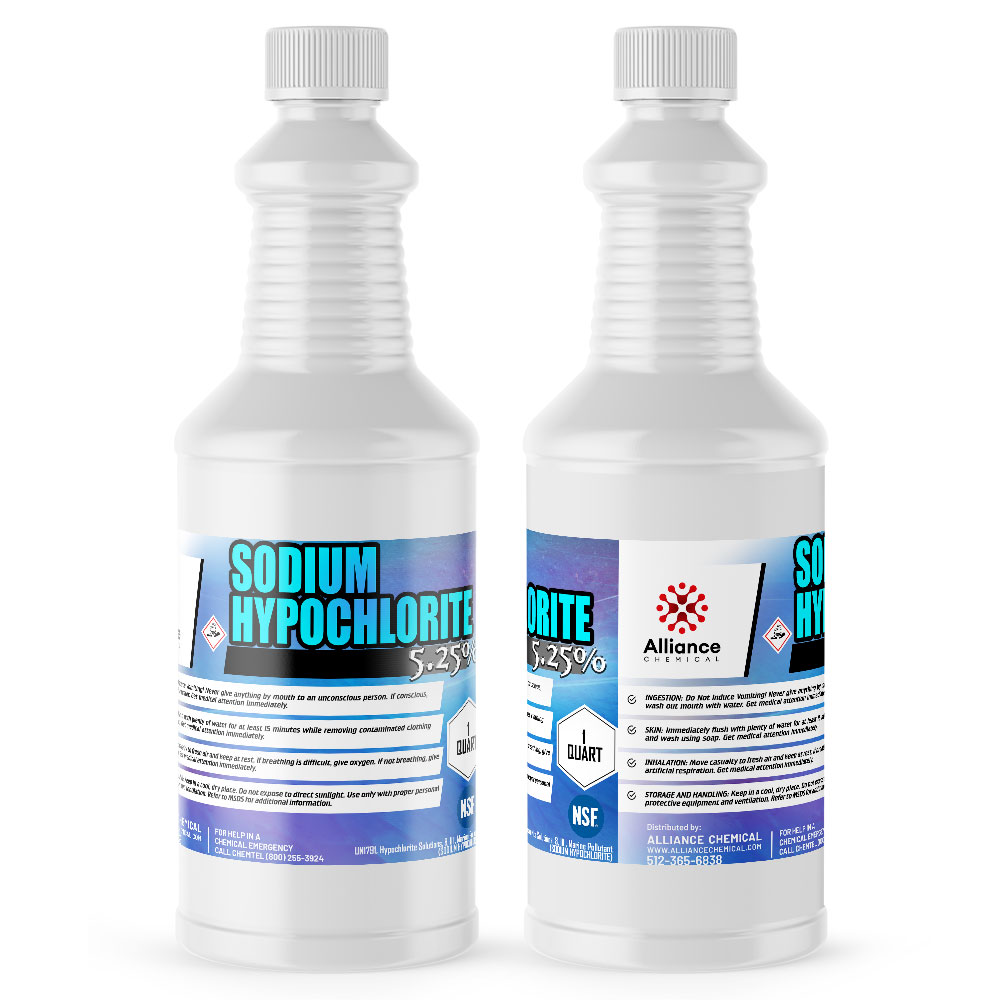
Sodium Hypochlorite

NaOCl 5.25% and 12.5% — bleach and sanitizer

8 Products
Sort by:: Best Selling
Sort by: Best Selling

FILTERS

Chemical name
  • (8)
Grade
  • (6)
  • (2)
Percentage
  • (1)
  • (1)
  • (1)
  • (1)
  • (1)
  • (1)
  • (1)
  • (1)
Form
  • (8)
Industry
  • (1)
  • (8)
  • (8)

About Sodium Hypochlorite

About Sodium Hypochlorite

Sodium Hypochlorite (CAS 7681-52-9) is an inorganic chemical compound and the active ingredient in liquid bleach, functioning as a powerful oxidizing agent and broad-spectrum disinfectant. It is primarily utilized in aqueous solution for municipal water disinfection, industrial bleaching, and wastewater treatment due to its high efficacy against bacteria, viruses, and fungi. At Alliance Chemical, we provide high-purity NaOCl solutions at precise industrial and commercial concentrations to meet rigorous regulatory and process standards.

Common Applications

  • Municipal Water Treatment: Secondary disinfection of potable water supplies to maintain a chlorine residual throughout distribution systems as per EPA Safe Drinking Water Act standards.
  • Well Water Disinfection: Shock chlorination of private and community wells to eliminate coliform bacteria and iron-reducing bacteria contamination.
  • Swimming Pool Chlorination: High-strength 12.5% solutions used for rapid pool shocking to break down chloramines and eradicate algae blooms.
  • Agriculture & Cultivation: Sterilization of irrigation lines and cultivation surfaces to prevent pathogen transfer in high-value crop environments.
  • Industrial Algae Control: Removal of biofilm and organic growth from cooling towers and external building surfaces using 12.5% concentrations.
  • Food Processing Sanitization: Cleaning-in-place (CIP) and surface sanitization in dairy and beverage facilities to ensure compliance with FDA food safety protocols.
  • Textile & Paper Bleaching: Industrial-scale whitening of fibers and pulp through controlled oxidative bleaching processes.

What We Carry

We supply Sodium Hypochlorite in concentrations ranging from standard household strength (5.25%) to high-test industrial strength (12.5%). Our solutions are available in packaging ranging from 1-gallon containers for facility maintenance to 275-gallon IBC totes for municipal and heavy industrial use.

Concentration Grade Best For
12.5% NaOCl Industrial/Water Treatment Municipal water, pool shocking, wastewater, industrial bleaching.
5.25% NaOCl Commercial/Standard Surface sanitization, commercial laundry, general disinfection.

Safety & Handling

Sodium Hypochlorite is classified under GHS Hazard Category 1B for Skin Corrosion (GHS05) and Category 1 for Serious Eye Damage. It is highly reactive and must never be mixed with acids (releasing toxic chlorine gas) or ammonia (forming explosive chloramines). Required PPE includes chemical-resistant gloves (nitrile or neoprene), splash-proof goggles, and face shields when handling 12.5% concentrations.

Storage must comply with OSHA 29 CFR 1910.1200 (HazCom) and NFPA 704 guidelines (Health 3, Flammability 0, Instability 1). Containers should be stored in a cool, dry area away from direct sunlight, as NaOCl decomposes at high temperatures and UV exposure. Transportation of concentrations above 7% is regulated under DOT 49 CFR 172.101 as UN1791, Hypochlorite Solution, Class 8, PG III. In case of contact, immediately flush the affected area with water for at least 15 minutes and seek medical attention. Link to Safety Data Sheets.

Sourcing & Quality

Shipped from Taylor, Texas — same-day on in-stock items.

COA included with every order. Certificate of Analysis documents lot-specific purity and specifications.

28 years serving 55,000+ customers including 244 federal contracts.

✓ SDS Included ✓ COA Available ⚡ Same-Day Shipping ★ No Minimum Order

Last updated: March 2026

Frequently Asked Questions

What is the difference between 5.25% and 12.5% sodium hypochlorite for pool shocking?
The 12.5% industrial concentration is approximately 2.4 times stronger than the standard 5.25% commercial bleach, allowing for faster breakpoint chlorination in swimming pools. Higher concentrations are more efficient for eradicating persistent algae blooms and breaking down organic contaminants, though they require more careful handling and PPE. Both solutions contain the same active CAS 7681-52-9, but 12.5% is the industry standard for commercial and municipal aquatic facilities.
How should sodium hypochlorite be stored to prevent decomposition?
Sodium hypochlorite is naturally unstable and decomposes over time, particularly when exposed to heat and UV radiation. To maintain assay strength, store NaOCl in opaque, UV-resistant HDPE containers in a temperature-controlled environment below 70°F (21°C). According to NFPA 704 standards, it should be kept away from incompatible materials like acids, hydrogen peroxide, and ammonia to prevent hazardous chemical reactions.
Is sodium hypochlorite regulated by the DOT for shipping?
Yes, sodium hypochlorite solutions containing more than 7% available chlorine are classified by the DOT as Hazard Class 8 (Corrosive) materials. Under 49 CFR 172.101, it must be shipped under the identifier UN1791, Hypochlorite Solution, and requires specific corrosive placards and proper shipping papers. Alliance Chemical ensures all shipments of 12.5% NaOCl meet these federal transportation safety requirements.
Can I mix sodium hypochlorite with other cleaning chemicals?
Never mix sodium hypochlorite with acids or ammonia-based products. Mixing NaOCl with acids (like muriatic acid) triggers the immediate release of toxic chlorine gas, while mixing with ammonia creates volatile chloramines, both of which are lethal if inhaled. Always refer to the chemical compatibility chart and OSHA 29 CFR 1910.1200 guidelines to ensure safe facility management and spill response protocols.
What is the EPA registration requirement for sodium hypochlorite used in water treatment?
When used as a disinfectant, sanitizer, or algicide, sodium hypochlorite is regulated as a pesticide under the Federal Insecticide, Fungicide, and Rodenticide Act (FIFRA). Municipal water treatment facilities must use NaOCl that is NSF/ANSI Standard 60 certified for potable water applications. This ensures the product meets strict purity requirements for lead, arsenic, and other heavy metal contaminants as mandated by the EPA Safe Drinking Water Act.
How do I calculate the amount of 12.5% sodium hypochlorite needed for well shock chlorination?
The amount depends on the depth of the well casing and the static water level to reach a target concentration of 200 ppm (parts per million). For example, 1 gallon of 12.5% sodium hypochlorite will treat approximately 625 gallons of water to a 200 ppm concentration. It is critical to calculate the total volume of the well column first to ensure complete disinfection without causing damage to well components or excessive residual chlorine.
What PPE is required by OSHA for handling industrial bleach?
OSHA 29 CFR 1910.132 requires employers to provide appropriate PPE for corrosive substances like sodium hypochlorite. At a minimum, handlers must use chemical splash goggles, a face shield if splashing is possible, and chemical-resistant gloves made of nitrile, PVC, or neoprene. For large-scale transfers of 12.5% NaOCl, a chemical-resistant apron and boots are highly recommended to prevent skin contact and chemical burns.
How does temperature affect the shelf life of 12.5% sodium hypochlorite?
Temperature is the primary driver of NaOCl degradation; for every 10°C increase in temperature, the rate of decomposition roughly triples. At 77°F (25°C), 12.5% solution can lose up to 1% of its strength per month, whereas at 95°F (35°C), that loss can accelerate to nearly 5% per month. Facilities should rotate stock frequently and purchase only what is needed for a 30-to-60-day window to ensure maximum efficacy.